I AM THE (WARD)LAW!
Alright ladies and gentlemen, you know what time it is! Men want to be him, ladies want to be WITH him. He's the one, the only, the amazing, cue drum roll, Wardlaw "The Law" O'Brien! Thank you, thank you, you are too kind.
Of course, no one can really reach the heights of Wardlaw, his raw power, his raw charm, his raw cunning, his raw ability to eat dozens of hot dogs in a single sitting. But with these little tips, maybe YOU can at least try to emulate a tiny fraction of his brilliance.
Part 1: Hit 'em with the clothesline
Alright so, you are middle in the fight, right, and your oppoent is just standing there. What do you? Well, the strategy is as simple as it is cunning: you wait for them to make a mistake and BAM!, you've hit 'em with a Massive Clothesline. That'll send 'em sprawling, and if there's a wall behind them (or the ringside, or whatever else), you can even hit 'em for half their health. And if their back are against the wall, and you can't clothesline 'em, then BAM!, you just Charge 'em instead. There's no escape from Wardlaw once the big man has you in his sights. Or maybe you Smack 'em Down and crash them into the corner. And once you got 'em in the corner, there's no escape from this Dangerous villain!
Part 2: No one puts Wardlaw in the corner!
But what if THEY put you in the corner? Well, just bounce off that wall to gain some speed and then smack 'em some! And maybe they are far away, and that's when you hit 'em with a crushing Overhead. So really, corners for Wardlaw are win/win/win situations, cause of course Wardlaw wins 3 times MORE effectively than anyone else.
Part 3: The Pain Train has no brakes
Maybe you let your opponent get a false sense of safety by letting him hit you a few times. But really, he was playing into your perfect plan all along. You create some distance, right? And then BAM!, you hit 'em with the Pain Train. Or maybe you flip off a wall and crush 'em with a Double Moustache Buster, a move that's sure to make all but the most hardened spectators swoon in pure delight.
Anyway, that's all you need to know about the fighting techniques of the great man himself. Just remember the ABCs: Always Be Clotheslinin'. With those words, you can't lose, and that's a guarantee!* And if you DO lose, your opponent was probably cheatin', so it doesn't count!
*(guaranteenotactuallyreedemeablepleasereadtermsandconditions)
Tuesday, 9 October 2018

Wednesday, 26 September 2018
The Stone Sculptor - A Story from the World of Indines
I wrote the following as one of the social goals for the BattleCON Unleashed Kickstarter in order to unlock new characters: it was interesting writing fiction for the first time in a long while, especially set in a lore that I don't know all that much about!
The town of Canath,
residing within the plains of Relecour, was tiny, no more than a dot
on a map. The only reference that Marmelee had managed to find
regarding it had been concerning some of the crafting and merchant
fairs that had occurred there, but that had been long ago.
Karin had deemed silly
all the research into every little town and village that met their
path, but to Marmelee it was important: the history of the world
wasn’t only there to preserve the mighty deeds of nations, kings
and rulers, but also the commonplace plight of regular people, living
out their lives while much more grandiose events occurred around
them. Canath was the sort of town that would have only risen to fame
if a famous battle had occurred near it and alas, it had failed to
gain even that distinction.
Yet history, and its
effect, permeated the place. A cursory look at the main features of
the town showed that it had started small, had rapidly expanded and,
upon reaching the zenith of its fame, slowly faded into obscurity:
this could be easily judged by the rather oversized, yet now
abandoned homes that dotted the perimeter of the settlement. Canath
had contracted down to a smaller core, leaving its edges to the
ravages of time and nature: falling apart, overgrown, or a mixture of
both.
While Karin had went
off to gather necessary supplies, Marmelee had taken her notebook and
asked some of the few remaining townspeople about the history of
Canath. The replies had been fairly standard, echoing the tales of
many other struggling communities: a curse had afflicted the town,
people had disappeared (more oft than not, further enquiry merely
revealed that they had left the town out of their own volition), and
the town had struggled with no influx of fresh blood. The main square
also alluded to glories gone and lost, with a weather-worn statue in
the middle of it, an inscription below it reading “Marek, last of
the Canath Family”.
Further questioning
elucidated the meaning of the plinth: the Canath had been the
original founders of the town, a rich merchant family. The statue had
been raised shortly after the loss of the last member of the lineage,
although most could not remember what had actually happened to him.
There was little more
to Canath: by all common reasoning, it was likely that its decline
had simply been due to one of the nearby city-states surpassing it
economically. Having finished visiting most of the town as the
mid-day sun arose, Marmelee reflected sadly that even in an
historical volume of her own writing (or, if she ever felt so bold,
maybe an auto-biography), Canath would be little more than a
footnote. The little stories, much like Canath itself, are always
lost to the ravages of time.
Marmelee made her way
back to the Inn. The Inn's location was another clue pointing towards
the relative unimportance of Canath, residing as it did near a
crossroad. If people had had motivation to actually visit the town
itself, such a busy Inn would have been nestled within the heart of
the town. Instead, the original innkeeper had decided to build it
much closer to the source of traffic.
As her thoughts
wandered, something caught Marmelee's eye. Near the perimeter of
Canath, a small wisp of smoke rose from a lonely chimney: a single
house still inhabited amongst the other deserted abodes, like a
single flame in the middle of an icy wasteland. Although initially
reluctant to disturb whoever lived there, Marmelee still had plenty
of time before she was due back, and it wouldn't hurt to quiz someone
else about the history of the town.
A small alley lead to
the house, flanked by wild brambles and vines. As she finally caught
full sight of the defiant house, she could see that it was being
maintained, although time still had had its effect on the outer
walls. Nature, on the other hand, had been held at bay: many of the
encroaching brambles had been neatly cut off before they reached the
walls, and a plain yet tidy garden could be spied behind a gate.
Marmelee hesitantly
knocked on the door, but as soon as she did, the door slowly crept
open, the lock on it seemingly having rusted to uselessness. The
inside of the house was relatively dark: even near midday, the
tightly packed housing and foliage meant that not a lot of natural
light filtered through. The entrance hall was fairly standard: old
chairs, a sofa, shelves stacked with books (the latter of which did
pique her interest).
“H-Hello? Anybody
home?” said Marmelee, in a whisper that almost defeated the purpose
of the question.
The only response was
silence. A few seconds passed, with Marmelee vacillating between
closing the door and heading back now,
or waiting a few seconds and then doing the same. Something caught
her eye, however: one of the walls was covered by countless statues,
each depicting a different animal: a trussa there, a dog (or maybe a
wolf?) and other animals native to the lands of Indines.
Even
from a distance, Marmelee could see that the craftsmanship was of the
highest order, an attention to detail that seemed to pick out all the
tiniest details, down to the individual hair. Gingerly stepping over
the threshold, Marmelee approached the statues, drawn to their beauty
more than anything else. On one of the shelves, she saw the most
beautiful statuette of them all: an insect, some sort of beetle, its
stone wings unfolded from their carapace and outstretched, so thin
that the stone was almost transparent. Marmelee carefully picked up
the beetle, bringing it up to her eyeline, inspecting it from all
sides.
“That's
my principal hobby, you know...”
The
unexpected voice startled her. Time slowed as the beautiful
sculpture danced in her hands, finally freeing itself from her grip
and falling to the floor, shattering the wings and chipping the main
body on impact.
“I'm
sorry, I'm sorry! Please forgive me, I didn't...I wanted...I will pay
you back, I swear! I'm sorry, I didn't mean to bother, I can leave,
please...I know that...” a deluge of apologies was uttered by
Marmelee, as the heat of embarrassment flushed her face.
“Calm
down, calm down”, said the man in a conciliatory way, “The joy is
in the making, and not just in the displaying.”
It
took a few minutes, and many repeated assertions that no, he didn't
need to be repaid for his loss, and that no, she didn't have to leave
and finally that yes, he would be more than happy to answer a few
questions about Canath.
“But
first, if you'll indulge me, I have a few questions of my own. You
are a Dryad, are you not? Do you hail from Amalao?”
A
shy nod was the response to both questions.
“Ah,
Amalao. Once again risen, yet still so hidden.”
The
panic now over, Marmelee was able to take more of a measure of the
man: his face was weather beaten, his hair grey but neat, and he
appeared to be around 50 years old for a human, yet his frame still
appeared strong. It was his eyes, however, that were the most
prominent feature of his face: behind squared spectacles, she could
see intense grey eyes.
His
name was Aden, and he had lived in Canath as long as he could
remember. His knowledge of the town, even before his time, seemed to
be encyclopedic, and Marmelee almost struggled to keep up as she
quickly took notes of the many stories that Aden told. Many of
Marmelee's theories seemed to be confirmed, especially in regards to
the decline of the town, but Aden seemed to know even about the glory
days. The hours lengthened and Aden lighted a few candles to
supplement the fading light, continuing quickly from where he had
left off once he was sat back down.
“Ah
yes, the titular family of Canath! Let me tell you, this place was
barely a farming village before they saw how valuable its location
would be to trade. They made a deal with the local baron, if I recall
correctly, although I'm not sure if that particular dynasty still
rules or was eventually supplanted,” the man continued, his
familiarity with history plainly clear.
“And
what of Marek? What happened to him?” enquired Marmelee, thinking
back to the statue that she had seen earlier in the day.
“The
famous last member of the Canath family. Truly, some say that the
fall of the town followed his disappearance, but who truly knows,”
said Aden: it was clear that he was taking some delight at being
questioned so.
“Is
that when the statue was raised?”, asked Marmelee while adjusting
her glasses, ready to take more notes.
“Yes,
just after he went missing. Maybe it was a way to cling to the past,
a way to show that the old, venerated family, even though now gone,
was still present within the heart of the city. Foolish really, but
when I was commiss...”
An
awkward silence followed. It was louder than the constant chatter
that had filled the room in the last hour or so, and Aden looked
flustered, like he had suddenly realised that something was wrong.
Marmelee only now realised how dark it was actually getting. After a
minute, Aden seemed to compose himself.
“Anyway,
anyway, as I was saying...” but his words were lost, as waves of
realisation washed over Marmelee. The statue in the square, old,
pitted and worn, yet the detail clear beneath the years of decay. The
precise, detailed knowledge that Aden seemed to possess. The scorn
towards the perceived thoughts of people that had long left the
living world. And finally but most importantly, the slip at the end.
Marmelee could feel cold dread building up inside of her.
“I
must leave! It's late, I m-must go...” she blurted out suddenly,
cutting him off mid-sentence. She quickly stood up, yet she was not
prepared for Aden's own speed, as he grabbed her by the arm.
“I
think NOT!”, he said, as he quickly but purposefully slipped down
his glasses. That was when she felt it, a force of magic erupting
from his eyes, like a dam broken, letting the river flow freely.
“Let
go of me!”
It
was unclear if it was the force of her own voice, or his own surprise
at the failure of his magic that sent him stumbling back. As soon as
he looked away, Marmelee could feel the magic essence ebb away.
“How?
HOW? You... you must be..,” said Aden as he stepped back, “You
came specifically for me, didn't you?! But no, NO, you won't get me,
I won't be taken!”
The
last few words were said almost in a shout, as Aden quickly turned
and ran from the room. Taken by surprise, Marmelee stood still,
gathering her thoughts and concentrating in order to bring her magic
powers to the fore, ready for anything.
Cautiously
she approached the door that Aden had gone through. Beyond, the room
was filled with different statues, this time not of animals, but of
various humans and other sentient races, some standing, some sitting,
all with a shocked expression on their faces. Room after room
followed this pattern, yet Aden himself was nowhere to be seen. And
as night approached, Marmelee knew that she would be missed if she
didn't head back soon.
As
she left the house, closing the door behind her out of some
unfathomable force of habit, her mind went back to the studies that
she had conducted in regards to her own race, her true race. No one
truly knew how many dragons had been left after the fall of the
Dragon Empire, or how many had decide to hide themselves, disguised
as humans. She knew one thing: what she had seen today was a mere preview of the the horrors that would be wrought upon the world if her father was allowed to awaken. In the past she had merely used the historical records to back her beliefs, but today she had seen living proof, and this steeled her with a fiery determination to do anything to stop the Dragon Empire from arising, once and for all.
Thursday, 5 April 2018
More a Simulation Than a Game: A Partial Pendragon Review
Ages ago, I went to a weekend convention with a couple of my friends, all of which were 18XX players. What followed was an entire weekend of 18XX games, from dusk till dawn. Call us crazy, but I had a good time and a good time was had by all. By the time Sunday came around, the last day of the convention, we were all a bit tired, so the game that we decided upon was 1853, the classic Francis Tresham game based on building railways in India.
 |
| This is an very old picture, mind you! |
The reason for the choice was that, overall, 1853 is a smoother ride than most other 18XX games. On a forum, I described 1853 as a game replete with gentlemen's agreements, one that you would imagine playing while sipping cognac, smoking a cigar and talking about the gold standard.
The gameplay of 1853 is very sedate, non-competitive and relaxed: unlike most other 18XX games, it's impossible to go bankrupt, it's impossible to have a company dumped on you, and the train rush is so sedate as to be almost leisurely. By some definitions, 1853 would not even be classified as a game (apart from the starting auction, which ultimately decides the winners of the game).
By the description above, you might think that 1853 is not particularly good, or even outright bad, but there is a charm to the game: the use of narrow and broad gauge track seems to be somewhat realistic, the railways in question seem to build organically, and there's something rewarding about seeing the end result of your decision making placed on a large, beautiful map. And thus, this was perfect for the Sunday that followed an entire weekend of 18XX games, all furiously, cut-throatingly competitive.
So what does this have to do with Pendragon? Well, the first time I played Pendragon, I had the same reaction to it that I had to 1853: the actual game mechanisms within Pendragon weren't exactly what I would consider "good" from a pure gameplay perspective, but the simulation aspects that Pendragon has, and the ability of the game to weave a story of the final decades of Roman Britain, truly make for an interesting and evocative game.
Now, to put things into perspective, I'm not saying that Pendragon is not competitive, or that it's anywhere close to how non-competitive 1853 actually is. My base of comparison is not between those two games, but between Pendragon and other COIN games. As you might know, I'm a huge fan of the proper use and minimisation of post-decision randomness in games. To me, although some aspects of COINs are completely random, the designs themselves discourage the use of randomness in order to win.
The best example of this is any of the insurgent factions, such as FARC from Andean Abyss. FARC can attack directly in that game, but they can only remove 2 enemy pieces at most, the attack has a chance of failure if they have below 6 guerrillas, and it reveals all of their pieces if they do it. Since being underground is so important in the game, this mechanism discourages the FARC player from attempting the action unless he can guarantee victory (using Ambush), or if the guerrillas are already revealed anyway, in which case there's no downsides from attacking.
All other COIN games in the series that I've tried (I've yet to play Liberty or Death) have followed this formula that disincentivises the use of dice. This could not be further from the opposite in Pendragon. A lot of the most crucial, necessary actions within the game use dice: raiding, which is one of the only ways for the Saxon and Scotti, determines the number of troops by randomly rolling a number of d4. The number of dice is determined by how much you wish to spend on each, separate raid.
The results of these dice rolls can have a huge impact on combat as well. Combat within the game is a curious beast: it is almost completely deterministic, although you can roll to have your troops either evade the enemy attackers, or attempt to ambush them, the latter of which allows you to cause damage before your opponents can strike.Although fully deterministic combat does seem to coincide with the dice minimising nature of COIN games, the actual combat diceroll does actually still occur: it's just the roll that you made when attempting a raid in the first place.
Due to the strict deterministic nature of combat, having one more or one less raider can make all the difference, and essentially decide whether you can storm that castle, or if there is no point in trying. In some ways, this meshing of random number of troops coupled with deterministic combat is the worst of both worlds, without the strength of a fully deterministic game or a purely random one.
The issues with the dice rolling do not stop there: another crucial aspect of the game is the "settle" special ability for the Saxons and Scotti. Settling is always used in conjunction with returning, an operation that allows you to return your victorious raiders with the plunder they collected. For every raider that returns in this way, you roll a d6 and for every 4-6 (or 5-6 for the Scotti), a raider is turned into a warband and placed in that region within Britain, which is ultimately the only way to actually start having settlements within Britain (apart from another special for the Briton factions).
The issue with this particular dice roll is that there is little way to mitigate it apart from having more raiders that you can convert, and if you blank out, that's an entire special action lost on basically a dice roll (and using special actions is a very valuable resource within any COIN game).
What strikes about Pendragon in comparison to most other COIN games is the constant, important use of dice, with a huge amount of post-decision dice rolls required in order to actually get anything done. Considering my tastes, I should have hated Pendragon, but I don't. I actually loved playing it.
Reading my criticism above, it might be hard to believe that this is the case, and I don't deny that many other games in which I've had similar experiences (I'm looking at you, Here I Stand) have been slated by me in the past. But, for all its shortcomings, within the beating heart of Pendragon lies a core of simulation that truly represents the era, and represents it well.
There is a dichotomy in wargaming where people want to have two slices of two completely different cakes: simulation and gameplay. To some, the simulation aspects of wargaming is what makes them important: how the game simulates the era, how it approaches the decisions and tactics used by one side or the other. To others, the simulation aspects are all well and good, but how good is the actual game as a means of competition?
To me, I require a little bit of column A, and a little bit of column B: I like the historical simulation aspect as well as the gameplay. Pendragon, however, is solidly within the simulation camp for me. The development of the game is a sight to behold: initially, the Britons hold strongly to the Island, while being under attack: eventually the enemies from without (and the petty bickering from within) prove too much, and concessions have to be made. Independence is gained from the Roman Empire, but even this is fragile, and soon the lords of Britain are at each other's throats. The raiding is random, but it is random for a reason: you never know how many Saxons or Scotti are going to disembark from their boats, or where exactly they are going to strike. The Saxons and Scotti can't really control how many of their people want to actually settle in Britain: they have to make do with what they get.
I played as the Civitates within my first game of Pendragon: they are basically the nobles and civilian elites that helped to rule Roman Britain. The other Briton faction is the Dux: the remains of the Roman Army, trying to either keep ties with the empire, or control Britain on their own. What truly amazed me as the Civitates is the amount of distaste I had for my erstwhile Dux ally by the end of the game: my Dux opponent had made it a mission to drive down my resources and wealth, to the extent that I couldn't wait for Britain to fragment so that he couldn't use up my precious resources.
Although I'm not a student of the era, this growing antagonism between the civilian and military sections of Britain seemed true to the premise of the game, and the way that it was grown organically within the mechanisms of Pendragon truly made the game feel special to me. On the other hand, the constant use of resources by the Army meant that some of my turns within the game were simply "Gain resources, then turn some of those resources into wealth" (wealth being a duplicate Civitates-only resource used in certain special actions).
Resource conversion isn't exactly the most exciting thing that you can do with a Operation + Special within a game, but as boring as it was, it made sense in the context of the game, and truly created a feeling that the army was appropriating my hard-won resources for their own needs, which just brought images to my mind of an angry noble plotting his revenge against the Dux after another taxing of his lands.
To me, the last anecdote encapsulates both what I love and hate about Pendragon. The game truly resonates as a depiction of an empire in decline, and it has such flavourful, colourful notes to it that it's hard not to fall in love with it. On the other hand, if you step back and strip Pendragon of all it's flavour, it's flair, it's incentives and subtle psychological tricks that it plays on you, the game itself is bare, unrewarding, random and ultimately, slightly non-competitive.
So would I recommend the game? Absolutely, if you want a unique experience. And absolutely not, if what you are looking for is an actual game. In the end, it is up to you to decide.
The gameplay of 1853 is very sedate, non-competitive and relaxed: unlike most other 18XX games, it's impossible to go bankrupt, it's impossible to have a company dumped on you, and the train rush is so sedate as to be almost leisurely. By some definitions, 1853 would not even be classified as a game (apart from the starting auction, which ultimately decides the winners of the game).
By the description above, you might think that 1853 is not particularly good, or even outright bad, but there is a charm to the game: the use of narrow and broad gauge track seems to be somewhat realistic, the railways in question seem to build organically, and there's something rewarding about seeing the end result of your decision making placed on a large, beautiful map. And thus, this was perfect for the Sunday that followed an entire weekend of 18XX games, all furiously, cut-throatingly competitive.
So what does this have to do with Pendragon? Well, the first time I played Pendragon, I had the same reaction to it that I had to 1853: the actual game mechanisms within Pendragon weren't exactly what I would consider "good" from a pure gameplay perspective, but the simulation aspects that Pendragon has, and the ability of the game to weave a story of the final decades of Roman Britain, truly make for an interesting and evocative game.
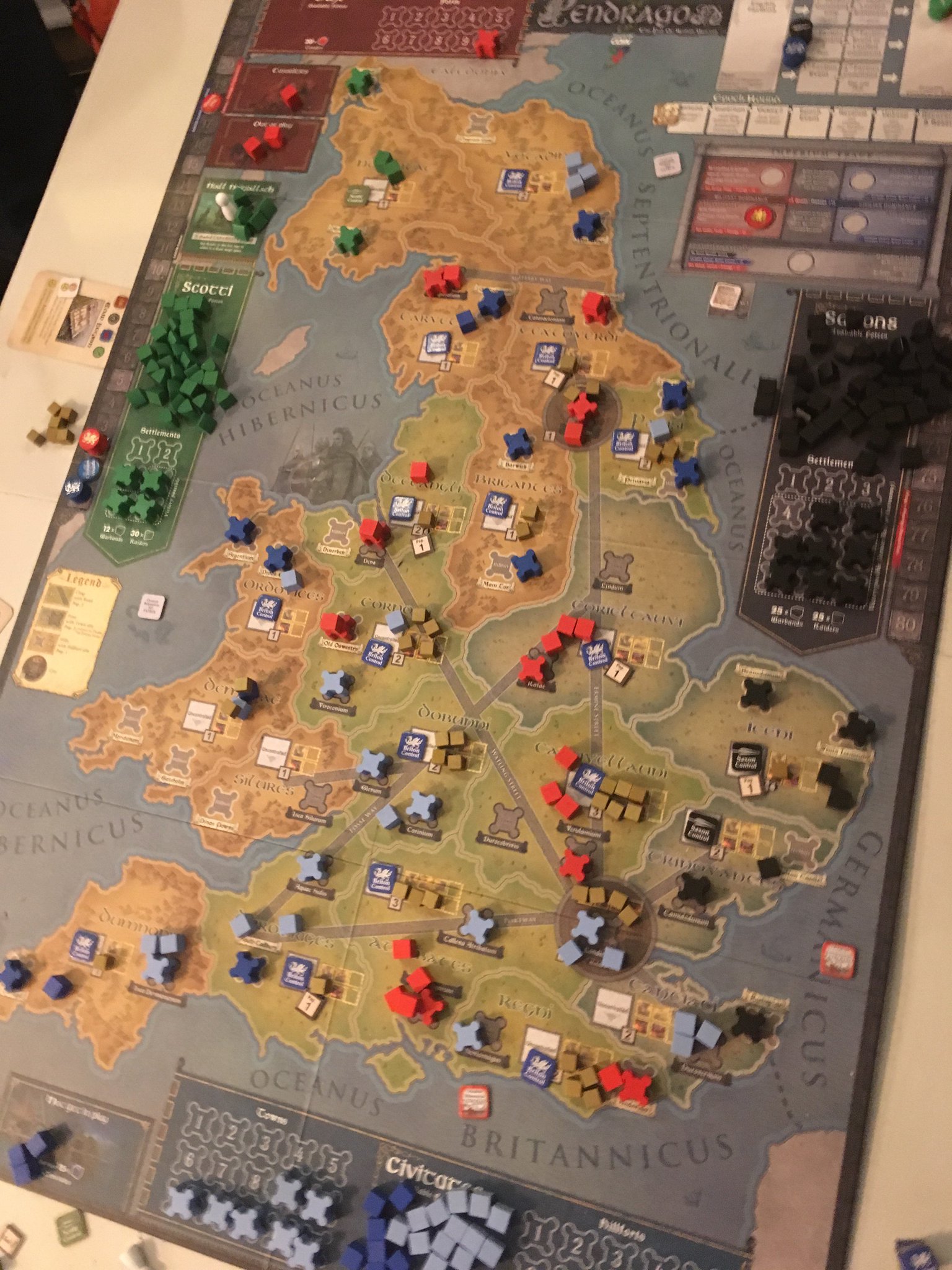 |
| First game of Pendragon I had, playing as the Civitates |
Now, to put things into perspective, I'm not saying that Pendragon is not competitive, or that it's anywhere close to how non-competitive 1853 actually is. My base of comparison is not between those two games, but between Pendragon and other COIN games. As you might know, I'm a huge fan of the proper use and minimisation of post-decision randomness in games. To me, although some aspects of COINs are completely random, the designs themselves discourage the use of randomness in order to win.
The best example of this is any of the insurgent factions, such as FARC from Andean Abyss. FARC can attack directly in that game, but they can only remove 2 enemy pieces at most, the attack has a chance of failure if they have below 6 guerrillas, and it reveals all of their pieces if they do it. Since being underground is so important in the game, this mechanism discourages the FARC player from attempting the action unless he can guarantee victory (using Ambush), or if the guerrillas are already revealed anyway, in which case there's no downsides from attacking.
All other COIN games in the series that I've tried (I've yet to play Liberty or Death) have followed this formula that disincentivises the use of dice. This could not be further from the opposite in Pendragon. A lot of the most crucial, necessary actions within the game use dice: raiding, which is one of the only ways for the Saxon and Scotti, determines the number of troops by randomly rolling a number of d4. The number of dice is determined by how much you wish to spend on each, separate raid.
The results of these dice rolls can have a huge impact on combat as well. Combat within the game is a curious beast: it is almost completely deterministic, although you can roll to have your troops either evade the enemy attackers, or attempt to ambush them, the latter of which allows you to cause damage before your opponents can strike.Although fully deterministic combat does seem to coincide with the dice minimising nature of COIN games, the actual combat diceroll does actually still occur: it's just the roll that you made when attempting a raid in the first place.
Due to the strict deterministic nature of combat, having one more or one less raider can make all the difference, and essentially decide whether you can storm that castle, or if there is no point in trying. In some ways, this meshing of random number of troops coupled with deterministic combat is the worst of both worlds, without the strength of a fully deterministic game or a purely random one.
The issues with the dice rolling do not stop there: another crucial aspect of the game is the "settle" special ability for the Saxons and Scotti. Settling is always used in conjunction with returning, an operation that allows you to return your victorious raiders with the plunder they collected. For every raider that returns in this way, you roll a d6 and for every 4-6 (or 5-6 for the Scotti), a raider is turned into a warband and placed in that region within Britain, which is ultimately the only way to actually start having settlements within Britain (apart from another special for the Briton factions).
The issue with this particular dice roll is that there is little way to mitigate it apart from having more raiders that you can convert, and if you blank out, that's an entire special action lost on basically a dice roll (and using special actions is a very valuable resource within any COIN game).
What strikes about Pendragon in comparison to most other COIN games is the constant, important use of dice, with a huge amount of post-decision dice rolls required in order to actually get anything done. Considering my tastes, I should have hated Pendragon, but I don't. I actually loved playing it.
Reading my criticism above, it might be hard to believe that this is the case, and I don't deny that many other games in which I've had similar experiences (I'm looking at you, Here I Stand) have been slated by me in the past. But, for all its shortcomings, within the beating heart of Pendragon lies a core of simulation that truly represents the era, and represents it well.
There is a dichotomy in wargaming where people want to have two slices of two completely different cakes: simulation and gameplay. To some, the simulation aspects of wargaming is what makes them important: how the game simulates the era, how it approaches the decisions and tactics used by one side or the other. To others, the simulation aspects are all well and good, but how good is the actual game as a means of competition?
To me, I require a little bit of column A, and a little bit of column B: I like the historical simulation aspect as well as the gameplay. Pendragon, however, is solidly within the simulation camp for me. The development of the game is a sight to behold: initially, the Britons hold strongly to the Island, while being under attack: eventually the enemies from without (and the petty bickering from within) prove too much, and concessions have to be made. Independence is gained from the Roman Empire, but even this is fragile, and soon the lords of Britain are at each other's throats. The raiding is random, but it is random for a reason: you never know how many Saxons or Scotti are going to disembark from their boats, or where exactly they are going to strike. The Saxons and Scotti can't really control how many of their people want to actually settle in Britain: they have to make do with what they get.
I played as the Civitates within my first game of Pendragon: they are basically the nobles and civilian elites that helped to rule Roman Britain. The other Briton faction is the Dux: the remains of the Roman Army, trying to either keep ties with the empire, or control Britain on their own. What truly amazed me as the Civitates is the amount of distaste I had for my erstwhile Dux ally by the end of the game: my Dux opponent had made it a mission to drive down my resources and wealth, to the extent that I couldn't wait for Britain to fragment so that he couldn't use up my precious resources.
Although I'm not a student of the era, this growing antagonism between the civilian and military sections of Britain seemed true to the premise of the game, and the way that it was grown organically within the mechanisms of Pendragon truly made the game feel special to me. On the other hand, the constant use of resources by the Army meant that some of my turns within the game were simply "Gain resources, then turn some of those resources into wealth" (wealth being a duplicate Civitates-only resource used in certain special actions).
Resource conversion isn't exactly the most exciting thing that you can do with a Operation + Special within a game, but as boring as it was, it made sense in the context of the game, and truly created a feeling that the army was appropriating my hard-won resources for their own needs, which just brought images to my mind of an angry noble plotting his revenge against the Dux after another taxing of his lands.
To me, the last anecdote encapsulates both what I love and hate about Pendragon. The game truly resonates as a depiction of an empire in decline, and it has such flavourful, colourful notes to it that it's hard not to fall in love with it. On the other hand, if you step back and strip Pendragon of all it's flavour, it's flair, it's incentives and subtle psychological tricks that it plays on you, the game itself is bare, unrewarding, random and ultimately, slightly non-competitive.
So would I recommend the game? Absolutely, if you want a unique experience. And absolutely not, if what you are looking for is an actual game. In the end, it is up to you to decide.
Monday, 26 February 2018
OCS: On Learning a System, Supply Lines and Story Lines
My very first contact with war gaming was with my father: when I was very young (10 years or less), I remember trying to play a couple of war games with him, including Luftwaffe (which, after rebuying it for him as a Christmas present, was actually worse than my prior recollection) and Tobruk, which unfortunately was far too difficult for me to play correctly. Both me and my dad, however, preferred video games, and largely that was my primary hobby, with board war gaming too difficult and "boring" for me to bother to get into heavily.
Although perfectly enjoyable, the game quickly ground to a halt due to the rules concerning Chinese intervention. The rules on that particular subject aren't great and basically meant that the US/UN player never really wanted to place his head into the noose.
I do think that this brief start into the hobby was, however, the germination of my subsequent love of board war gaming. About 7 years ago, I became heavily invested into board gaming and from that sprang a renewed interest in board war gaming as well.
There was still one issue that bothered me: most of my war games at the time were either CDGs or COINs and the only hex 'n' counter games that I played were No Retreat or Unconditional Surrender. I always wanted to try one of those good old fashioned hex games and with no interest in tactical exercises, my attention was drawn towards OCS, a series that, at least in my circles, had drawn nothing but praise.
With years of practice of reading rulebooks, the series rules for OCS didn't seem that daunting, but my initial foray into the game was, quite frankly, a disaster. OCS is one of those games where reading the rulebook can tell you how to play the game, but doesn't tell you how to play the game. What I mean by this is that OCS suffers from that peculiar issue that Napoleon's Triumph also suffers from: the rules can tell you how to move and attack with your pieces, but this hides the intricacies of the system and the tactics and strategies required to actually bring the fight to the enemy.
Most other war games I had played previously were what are pejoratively known as front-pushers. Usually this is due to the scale, but in those sort of games you don't really need to worry about supply inasmuch as you just need to insure that there aren't any enemies between you and your back line. When I first looked at my troops in an OCS game, I had no idea of how to bring them to combat with the required logistical network that would allow them to fight. My previous experience in war gaming had not prepared me for the requirement of figuring out where to set up my supply dumps and actually get supplies to that point.
Plagues by indecision (and this coming from someone that considers himself a fast player), my troops stood still, and minutes turned into hours. Finally, I gave up. OCS had beaten me already and I barely had played a single turn of it.
At that point, I sort of gave up on my attempts at the series. I wanted to get into it, but learning how to actually play the game seemed too large a step, and I felt that I neither had the time nor perseverance to actually be able to enjoy the series.
This sorry state of affairs remained until MMP released Reluctant Enemies. Reluctant Enemies is a low counter density OCS game based on the oft-forgotten battle in Syria between the Commonwealth and Vichy France. Reluctant Enemies was made primarily to get people into the system: along with the low number of counters, the box has a very useful "Learning OCS" booklet. I ordered the game almost immediately: if this didn't manage to teach me OCS, then it was clear the system was not for me.
 |
| Starting setup of Reluctant Enemies |
Fortunately, I rather enjoyed my time with Reluctant Enemies. The game is a bit of a microcosm of the OCS experience, including a small but important air war, sweeping tank advances in the Syrian desert, and entrenched infantry fights nearer to the coast. Crucially, the game taught me the importance of setting up supply dumps (and protecting them) along with the importance of setting up reserves so that you can react to the actions of your opponent.
The latter is especially important in terms of understanding how to play the game properly, because setting up reserves is crucial to the flow of the game. Reserves are primarily used either offensively or defensively. When used offensively, you can release them during the exploitation phase in order to exploit gaps in your opponent's defence. Defensive reserves can either be used to plug up gaps in your line before they develop (as reserves are the only units that you can move during an opponent's turn).
The other important lesson that Reluctant Enemies taught me was the importance of initiative. OCS doesn't use a simple I-GO-U-GO system: instead, at the start of each turn, both players do a straight dice-off to see who gets to decide which side moves first.This can potentially lead to someone getting two turns in a row, which is more than enough to crush a weak defensive line. The key to the game is therefore to put your opponent into situations in which they have to go first, thus continuing to allow you to get a double turn in the future.
With this small success under my belt, I went on a veritable spree of buying all the OCS games that interested me (many of which were out of print): Sicily II, Tunisia II, Korea, DAK and Burma. Sicily II was my next serious attempt at the series, and although I stumbled due to the heavy emphasis on amphibious assault, it was an enjoyable experience.
 |
| Tunisia II starting setup. |
My next attempt was Tunisia II. Overall I think Tunisia II is a better start into the system than Reluctant Enemies. The start of the campaign has a similar number of units present, and Tunisia II has the benefit that the battle gets progressively larger as more reinforcements arrive, allowing you to expand the game as you learn. As well as that, Tunisia II is quite an interesting tactical/strategic exercise in comparison to Reluctant Enemies: this is due to the fact that there are only three avenues of attack in Reluctant Enemies and all three bog down due to either rivers, mountains or both. As such, success in Reluctant Enemies is heavily reliant on rolls going your way, rather than tactical acumen.
This is not to say that Reluctant Enemies doesn't do a stellar job of getting people into the series, but after playing the other OCS titles that I bought, there wasn't really any reason for me to go back to it: it just doesn't have the staying power that the other games in the series have, and there's nothing exceptional about Reluctant Enemies that would make someone want to play it over Tunisia II or DAK.
The next game I tried was Korea, which was enjoyable (to a point). I played as the North Koreans, facing the South Korean and UN troops played by my regular OCS opponent.
 |
| North Korean troops driving down the peninsula |
The start of Korea was enjoyable, with me quickly surrounding Seoul and then driving down to Pusan and setting up a perimeter, as US troops arrived to bolster the South Korean defenders. The game played pretty historically, with my opponent then making his landings at Incheon, quickly forcing my troops back.
Although perfectly enjoyable, the game quickly ground to a halt due to the rules concerning Chinese intervention. The rules on that particular subject aren't great and basically meant that the US/UN player never really wanted to place his head into the noose.
Not being a game designer myself, I couldn't really think of a way to get past this problem while still using the basic framework of an OCS game, which also highlights one of the limitations of attempting of series-style games: it becomes difficult to create bespoke solutions to specific events in specific conflicts, which is largely the reason why OCS hasn't really deviated trying to portray World War II or World War II-style conflicts.
To be clear, this isn't the only issues with OCS: there are oft-discussed topics such as the power of air forces and the cheapness of them (in terms of supply) in comparison to artillery barrages. Or how the game due to its limited ZOC (Zone of Control) effects allows for unnatural shuffling of front-lines that would have never happened historically. I have been aware of these criticisms of the system and I don't completely deny that they are issues with the game, but overall these points do not detract from the fact that the system has provided me with incredible story lines of past battles. This especially has been an highlight of the system for me: my first attempts at any of the games described above have shown me the reasons why the battles unfolded as they did, even though if the schedules in most of our games weren't exactly the same as the real life results. And this point was made abundantly clear to me when I played Burma II.
 |
| Starting setup of Burma II (note the 17th Indian almost completely surrounded) |
Burma II focuses on the U Go campaign, one of the last offensive campaigns of the Empire of Japan. The game starts with both sides attacking and defending, with an offensive against Imphal/Kohima by the Japanese and an offensive in the east by combined US and Chinese offensive. One of the highlights of the game is the rather extreme logistical position that both sides are in, especially in the hilly terrain of the Naga Hills, where trucks are basically unable to function, forcing both sides to rely on mules to cart their supplies to the front. The game progressed pretty historically, although my Chinese/US troops didn't manage to dislodge the resolute Japanese defenders and I also lost Kohima too quickly when compared with real life. With Imphal under siege, I was forced to use my planes to ship supplies there, with the Japanese pushing ever closer and using infiltration tactics to push past my defences. However, the logistical situation for the Japanese near Kohima was dire, and even with several mule convoys, it was difficult for them to both fight and remain in supply, which highlighted both for me and my opponent how crazy the attempt to attack Kohima was.
 |
| Imphal under siege. |
What was made abundantly clear to me, however, was the effect that the OCS supply rules have on the game. Although some criticise the game for bean-counting due to the way that supply is handled, forcing players to use mules and trucks to move supplies allows the game to have movement effects on the supplies in question and showcases how different types of transport have to be used: trucks are fast, but only on roads, while mules move slowly, but can be used in smaller trails. As well as that, the tightening noose of the Imphal siege made me worry about every single supply token that I used: the game finally ended with my troops opening the Kohima/Imphal road, but not before my supplies in Imphal had been pushed to the brink: a couple more attacks and potentially that whole front would have collapsed, and I only managed to open the road in the nick of time.
This, to me, was the most powerful image that I have ever experienced in a war game. My troops surrounded on all sides, with supplies dwindling and only my transport planes to feed them: the liberating relief forces slowly, painfully fighting for every inch in order to reopen the road and then the triumphant feeling of re-opening the road and the trucks finally bringing in supplies again.
And this is largely why I've fallen in love with the system. Most of my previous wargaming was done at the strategic or grand strategic level, and now I finally understood why people were so invested into playing at the operational and tactical levels: the results feel more personal and the story lines created by the games are richer and more rewarding. It's hard to bring in the human element when you are playing something at the Corps or Army-level.
As such, if you get a chance to try out OCS, I would suggest you go for it. The system has faults, but I don't think they detract from the games, and the system will allow you to see that what was truly important was not only the location of troops, but also their access to supply and the difficulties of bringing supplies to the front. And understanding this can only lead to a deeper understanding of the conflicts in question and why certain campaigns unfolded as they did.
Tuesday, 9 January 2018
Sekigahara, the Beauty of Simplicity
It's weird for me to reflect back to the number of times I heard people sing the praise of Sekigahara, and for me to never have been sufficiently interested in the game to actually get it, or ask someone that had the game to play it with me. Maybe it was just a lack of interest in the era/war, but I've had situations in the past where I wasn't interested in a particular conflict until I played a game centred around it.
Hence, Sekigahara's elements of poker shine to the fore, and your poker hands are not only the blocks and their composition within the map, but also how they interact with the hand of cards that you have, leading to endless, cascading possibilities for bluffing, double bluffing and pulling out desperate, end of game acts that somehow manage to actually work out in your favour.
What truly amazes me is that, even on the day that I finally tried playing it, Sekigahara had been selected as a game of last resort. My friend and I had planned to get a game of Colonial Twilight in, but realised that after setup and rule explanation, we wouldn't have enough time to complete it. So we rummaged through my friend's game collection to find a 2 player alternative. Going through the collection, it was pointed out fairly early that Sekigahara would fit, but still we continued searching, only returning to the game once we had exhausted all other options.
With hindsight, it now almost feels like destiny was conspiring against me, trying to prevent me from playing a game that could potentially become one of my favourite games ever. And strangely, I feel confident in asserting this now, even after only having played the game once and even though me and my friend got more than a couple of rules wrong. Sekigahara is truly that good.
At this point, I could almost finish this review, although this would be a disservice to the reader, since I haven't plumbed the depths of what makes the game interesting. Sekigahara has elements of one of my favourite games ever: Napoleon's Triumph. Napoleon's Triumph is a game that I have compared to playing poker with 5 hands at once, and this simile is even more apt in Sekigahara.
To understand why, it is first of all important to understand the chief mechanisms of Sekigahara. The game resides within the category of 'block war games', a sub-genre of wargames in which usually the strength of a particular piece is kept hidden in order to create a fog of war. This can lead to interesting decisions: is that huge block of enemy units actually a threat, or are they under-strength? Can I bluff my opponent into not attacking by seeming to be strong where I'm actually weak? Although these sort of mechanisms are present even in hex'n'counter wargames through the use of the stack, they are principal within block wargames.
The main difference between Sekigahara and most other block games is the way that combat is represented within the game. Usually, in block wargames, you have simple X+ to hit systems when you are fighting. Sekigahara, instead, uses a system that is both mechanically interesting and (after a brief read of the designer commentary present within the rulebook) true to the era.
The way it works is that you have a hand of cards, with most of the cards having an emblem (called a mon in japanese) of one of the daimyo fighting on your side. During fights, you can only reveal blocks (and thus add their strength) if you play a card matching the block's mon. If you don't have a card, that block won't fight, which represents the shifting loyalties and intrigue that was a principal part of the conflict. You also get bonuses for revealing mon of the same clan during a single battle, as well as using special cards to activate the bonuses of arquebusiers or cavalry.
In essence, the game rewards you for both bringing to the fight the right army combinations as well as ensuring that you have the right cards to fight at the right time, which to me felt like a mix between Napoleon's Triumph (where army composition is the only determinant of who wins a fight) and Maria (where you are trying to exploit particular hands of cards while bluffing your opponent into not attacking areas where your hand is weak).
Hence, Sekigahara's elements of poker shine to the fore, and your poker hands are not only the blocks and their composition within the map, but also how they interact with the hand of cards that you have, leading to endless, cascading possibilities for bluffing, double bluffing and pulling out desperate, end of game acts that somehow manage to actually work out in your favour.
But what is truly incredible of this game is that Sekigahara is able to pack so much depth in such an easy and quick to play package. The rules, for anyone that is familiar with the depths that wargame rulebooks can plunge in, is almost an exercise in simplicity. A few neatly laid out pages are all that divide you from taking off the shrink-wrapping and actually playing the game. It is incredible that, in a 20 page rulebook, only 11 pages are reserved for the rules while the rest are left for historical analysis and designer notes.
Wargamers, depending on how far they have dived into the hobby, are used to ponderous tomes or rulebooks of truly biblical size, but sometimes there is something to be said about a game that takes 10 minutes flat to decipher. This is not to say that heavier rulebooks necessarily lead to worse games, and some of my favourite wargames have rulebooks that I have puzzled over again and again, but simplicity, especially in a hobby which has quite significant barriers to entry, can be a virtue.
With such gushing praise of the game it can't be a surprise that I would recommend anyone, even non-wargamers, to at least try the game. To me, Sekigahara, much like Napoleon's Triumph, is a true showcase of how wargames can innovate, grow and reach broader audiences, and to do it in a small, easy to digest package that is unlikely to scare off an interested party, like many other, more complex games can. To me, simplicity and efficiency of rules has as much a place in the wargaming hobby as large, complex and strategically/tactically deep games.
Tuesday, 28 November 2017
"Let me just play your entire turn for you": An Alpha Gamer's Guide to Co-ops
"Hi, my name is Tekopo and I'm an Alpha Gamer"
Slow claps from the others in the meeting.
"Sometimes I just can't help myself 'helping' other people when they perform their turns in a co-op even though I know I shouldn't. Look, I know everyone here knows those moments when one of your friends is making a move that is OBVIOUSLY less than optimal, and you feel a need to interject and tell them what to do. I know this is a bad thing and I shouldn't do it..."
General nods from the audience.
"...but I feel this isn't a problem with me. It's a problem with the game!"
Audible gasps can be heard, people start shouting.
"Now wait, let me explain! Basically, if the game is..."
Before he can finish, Tekopo is dragged away by men in black suits...
Slow claps from the others in the meeting.
"Sometimes I just can't help myself 'helping' other people when they perform their turns in a co-op even though I know I shouldn't. Look, I know everyone here knows those moments when one of your friends is making a move that is OBVIOUSLY less than optimal, and you feel a need to interject and tell them what to do. I know this is a bad thing and I shouldn't do it..."
General nods from the audience.
"...but I feel this isn't a problem with me. It's a problem with the game!"
Audible gasps can be heard, people start shouting.
"Now wait, let me explain! Basically, if the game is..."
Before he can finish, Tekopo is dragged away by men in black suits...
Friday, 24 November 2017
Difficult Decisions and Designing History: A Colonial Twilight Review
As shown by the very sporadic updates in this blog, my policy of reviewing games is mostly concerned with finding something interesting about a particular game, something beyond just judging the game based on its merits. Lately, the only game that has truly inspired me to write again has been Colonial Twilight, and the reasons why this game is interesting both in terms of a game and also in terms of analysis are multiple.
First of all, an introduction: Colonial Twilight is one of the latest offerings in the long-standing GMT COIN series. COIN (standing for COunter-INsurgency) are games that mostly seek to simulate unconventional warfare, with conflicts such as the Colombian FARC insurgency in the 90s, the Cuban Revolution, the war in Afghanistan and even the American Revolution. Overall, I'm a big fan of the series and currently own all volumes apart from one.


The special abilities for the Government are the standard Troop Lift (which is comparable to the Coalition's Airlift in terms of power), Deploy (which is also comparable to the Surge ability of the Coalition, although it has the extra effect of also allowing you to depopulate an area) and, finally, Neutralise, which allows the government to destroy enemy pieces even with a special action, although it does by creating opposition to the government in the area.
First of all, an introduction: Colonial Twilight is one of the latest offerings in the long-standing GMT COIN series. COIN (standing for COunter-INsurgency) are games that mostly seek to simulate unconventional warfare, with conflicts such as the Colombian FARC insurgency in the 90s, the Cuban Revolution, the war in Afghanistan and even the American Revolution. Overall, I'm a big fan of the series and currently own all volumes apart from one.
At first, however, I was hesitant to buy Colonial Twilight: after all, I had plenty of other volumes that dealt with 20th century insurgency, so buying another one that fit that genre seemed slightly superfluous. What partially convinced me, though, was the fact that Colonial Twilight was made as a two player, while all other volumes were created as 4 player games (some, I would argue, to the detriment of the game). The other, important factor that finally made me decide to buy the game was that, from a historical aspect, the French-Algerian war could be said to be the birthplace of COIN warfare, and thus the birthplace of the very mechanisms that populate the COIN series of games.

Much like Cold War theories such as the Domino Theory impact and inform the mechanisms within Twilight Struggle, the theories as espoused by David Galula (an officer that took part in the Algerian Insurgency, and then wrote two books about his experiences), underpin ALL of the mechanisms present within the COIN series, specifically concerning the dichotomy between controlling a population and actually having support from that population (even though the actual support could only be present in a small minority of the people in an area).
The Colonial Twilight playbook (the historical notes and developer diaries within these books are wonderful, and I wish more games produced developer commentaries because it's an interesting insight in the design process that the designers go through) does acknowledge this, providing an entire section on the writings of David Galula and his effect on both COIN theory and the COIN series as a whole.
With the above in mind, what makes Colonial Twilight really stand out to me is its purity in terms of adhering to the historical COIN analysis. Due to the 2 player dynamic, there isn't much for the players to get sidetracked by: you have only one enemy to worry about, and the victory conditions are crafted in such a way that you will have to be pro-active in order to win the conflict. Although I do love the politics and deals involved in other COINs (A Distant Plain is especially good thanks to the Coalition/Government dynamic), there is something to be said about playing a game where the only concern is to run an insurgency or counter-insurgency operation as efficiently as possible. In this regard, Colonial Twilight truly shines.
The mechanism that turns a standard 4 player COIN into a 2 player COIN, while keeping all the flavour, is also truly innovative. Instead of the standard initiative track, you get the following:

The way that it works is that the first eligible player can play in any of the spots, while the second can only place his tracker on a space adjacent to the one that the 1st eligible player placed his. So, for example, if the 1st player places on "Execute Limited Op", the 2nd player can place on "Execute Op only", "Execute Op & Special Activity" or "Pass", but not on "Execute Event". Then, when determining initiative for the next turn, the shade of the spot determines who is first and second.
Although weird at first, especially if you are used to the standard COIN mechanism, this mechanism is quite elegant and, coupled with the fact that you can't see one card into the future like other COINs, can make players potentially make sub-optimal decisions in order to keep the initiative one more turn. It's clear that in order to make a 2 player COIN work at all, some innovations had to be made, and Colonial Twilight does not disappoint.
The factions within Colonial Twilight play in a pretty standard way, if you have played COIN games before. The French government has the familiar array of Train/Sweep/Assault, with the only deviation is that, because no Lines of Communication or Economic Centres are present, there is no Patrol action. Instead, Garrison is present, an action that allows you to place police pretty much anywhere.
This, to seasoned COIN government players, might seem like an incredible ability: starting from Andean Abyss, one of the most important factors that affect government strategy and tactics is "how to place police out of the cities and into the countryside". In other COIN games, the only ways to do it are usually either placing the police there during a redeploy, or creating a base (which is a limited resource) and then training police in that area. So being able to place police in an area directly is quite a powerful tool.
The special abilities for the Government are the standard Troop Lift (which is comparable to the Coalition's Airlift in terms of power), Deploy (which is also comparable to the Surge ability of the Coalition, although it has the extra effect of also allowing you to depopulate an area) and, finally, Neutralise, which allows the government to destroy enemy pieces even with a special action, although it does by creating opposition to the government in the area.
One final thing that distances the COIN faction in Colonial Twilight is the fact that you have both Algerian and French troops. Algerian troops are easier to get onto the board, but are limited in number and also can be subverted by the insurgents. The French pieces can only be placed on the map through a deploy, but have the additional benefit that they cause attrition on the insurgents if attacked.
The insurgent faction, the FLN, is also very similar to other insurgents factions such as FARC, the 26th July Movement and the Taliban. They can rally, march, attack and terror, with the only major difference being that their terror can never create opposition, just remove support. For special activities, they have extort (present in many other insurgent factions), subvert (which allows them to remove/replace Algerian forces) and a slightly weaker version of ambush, which only removes a single enemy cube and doesn't create a new insurgent unit.
By this point in this large, rambling review you might be wondering how any of this applies to the title that I have given this post. The "Difficult Decisions" that I refer to (although difficult decisions are a standard in the series) refer to one of the more interesting and innovative mechanisms that are present in the game: the Pivotal Cards.
Old COIN hands might be wondering why I would call such a mechanism "innovative". After all, Fire in the Lake had already showcased the use of pivotal event. What sets apart the pivotal events in Fire in the Lake and Colonial Twilight, however, is the number of pivotal events afforded to each side (1 per side in Fire in the Lake, 3 per side in Colonial Twilight), and, principally, the fact that a lot of the pivotal events within Colonial Twilight are not as unequivocally good for the player playing when compared to FitL pivotal events (although the Tet Offensive event for the NLF in FitL does have some downsides).
This is what truly interested me in the game after that first play: the pivotal events make for some head-achingly difficult decisions and can really change the flavour of the game if they are played or not. They also inform what kind of strategy the player is attempting. The mobilization event, for example, frees up a lot of French units essentially for free, and is potentially the start of a larger offensive from the French player, but can only be played if the victory condition of the FLN player has reached a certain threshold: does the FLN player thus attempt to slow down his own accumulation of points in order to reach that point or not?
The Mobilization event itself provides a further interesting and difficult choice: if the card is played, it allows the FLN player to play the pivotal event that allows access to Morocco and Tunisia, areas that can potentially house up to 6 insurgent bases in relative safety. But, if the Morocco and Tunisia cards are played, the French player has the option to start building border controls, which decrease the number of resources that the FLN player receives at each propaganda phase. It's difficult decisions, nestled into difficult decisions, nestled in other, even more difficult decisions.
The Suez Crisis is more straight-forward: the FLN player can play it at any time to remove French troops (temporarily) and resources, but it also costs the FLN player resources that they only get back on the next propaganda phase. Does the FLN player slow down his tempo in order to remove some French troops momentarily? That's also not an easy choice to make.
The final three pivotal events are Coup D'Etat, Recall De Gaulle and OAS, the former both French event and the latter being an FLN event. Coup D'Etat is literally a dice-roll: it could be good or bad for the French depending on what you roll. Recall De Gaulle can only be played if at least one Coup D'Etat has been played, and allows the French player to disregard penalties for casualties substained as well as making it easier to train in the countryside, while OAS is a powerful new special ability that can only be played if Recall De Gaulle has been played, and basically allows you to perform terror anywhere on the board, while also decreasing resources for the FLN player.
Coup D'Etat is principal in showcasing that most pivotals in this game are double-edged swords. While all other pivotals can only be played once per campaign, Coup D'Etat can be played once per campaign (ie the time between one propaganda card and another). But why would you want to play it? One of the central things about pivotal events that I haven't touched upon yet is that they also gain you the imitative as well as cancelling the current card played from the deck. Is there a particularly bad event that you want to prevent your opponent from playing? Playing Coup D'Etat (or really, any pivotal event) can get you out of that pickle. You might have a negative effect from the Coup itself, but sometimes that's preferable to the previous event being played.
Recall De Gaulle, on the other hand, is probably one of the most difficult decisions in the game. Although it does make peacekeeping in the countryside a lot easier, OAS is truly one of the most game-changing abilities in the game and can quickly lead to the government losing the lead, or even the FLN running out of resources. Thankfully, Coup D'Etat can potentially be used to get rid of both Recall De Gaulle and OAS, but the difficult decision remains. Crucially, it is possible to win as both sides without playing ANY of the pivotal events, and the wonderful thing about them is that they truly change the flavour of the conflict if they are played or not, instead of just helping/hindering one side or another like the FitL pivotals.
One other aspect that ties in with the pivotals is that there are many capabilities in the game that affect both side. One of these both makes the Neutralise special ability better, but also gives a further penalty to the French player for using it. Overall, the game is absolutely swimming in these difficult "will this help or hinder me more?" decision spaces, and for that, it should be commended.
Considering all of the above (and cutting short a too-long article), I would say that Colonial Twilight certainly has the possibility of being one of more favourite COINs, alongside A Distant Plain. From a historical perspective, it is interesting (and certainly has made me want to read more about the conflict and rewatch The Battle of Algiers, a very thought-provoking film about the French-Algerian War), and from a gameplay/mechanisms perspective, the duality of many of its events really make the game stand out. If you are looking for a COIN game that doesn't require 4 people or even if you are entering the series for the first time, I would strongly recommend this volume in the series.
Subscribe to:
Comments (Atom)