Wednesday, 13 August 2014

The Importance of Components

This is a subject that I've thought about for a long time and it feeds into the sort of mentality that I have when it comes to games. Now, I'm a huge proponent of mechanisms, gameplay and just the general 'feel' of a game when it comes to deciding what is worth my interest and what doesn't. As such, I have usually no qualms about playing games that are visually unappealing if I consider them to suit my tastes.

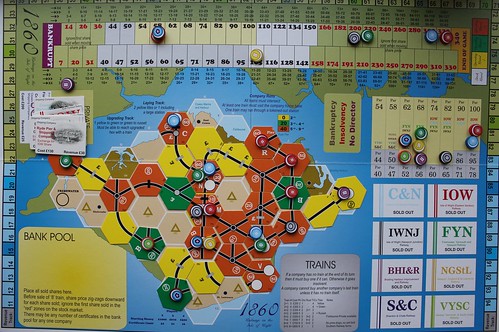
The extremes of this is 18XX: there are plenty of games within this genre that aren't just unprofessional, but downright ugly, cluttered and obviously designed by the creator of the game rather than a professional graphic designer. This is especially apparent in 1860, since the game map is, quite bluntly, a mess. Even then, I have played and enjoyed 1860.

This article, however, is not about me, but the general feelings that most other boardgamers have and even some of my own biases against certain graphical/production designs. What this article will not examine, however, is the so-often mentioned divide of boardgames into strictly euro/american designs, a distinction which I find is nowadays evaporating so rapidly that the distinction, even if they were valid once upon a time, is essentially gone nowadays.

Design is important in a number of ways, but it is important to first outline that, much like enjoyment/fun, graphical design does have an element of subjectivity to it: what someone might find appealing might be entirely unappealing to someone else (something which I will showcase later by examining my own biases). This is not to say that the graphical design of a boardgame cannot be evaluated from an objective basis, however.

As I'm not a graphics designer I won't outline every single possible sin that is possible to commit, but some of the foremost ones would be things like including too much writing on the board: 1860 is pretty guilty of this, with the entire board circled by rules explanation boxes. Writing on a board should, I feel, be restricted to simply labeling rather than explaining.

As an example, look at the aforementioned 1860 board below:


Although better than other 18XX boards I've seen, it looks seriously cluttered in terms of writing. If you need to explain something without having the player reference the rules, I always feel that a game is better served by cheat-sheets, something that GMT has obviously taken to heart. 

I have to admit that there have been too many times to count when someone approached a table when I was playing an 18XX game and said 'man this game looks hard'. Maybe that can be attributed to the nature of the genre, but a part of it is also the graphical design. As much maligned as the graphical redesign of the new(ish) version of 1830 was, it does look more inviting to a potential new player, which strikes at one of the issues that I think is most important when discussing design: accessibility.

The first contact that a new player makes with a game is the design of it: they look at the components, analyse the board and are immediately given an impression of what the game is and the general feel of it. If they see a bunch of wooden cubes on the board, they are going to be given a different perception than if they see sculpted plastic miniatures. Their initial assumptions about the game might be incorrect, but that first impression is a powerful motivator for wanting to play the game (or not). 

It's why it can be important to be immediately visually striking: an awesome example of this is Cash 'n' Guns: if you watch a game of it from the distance you are immediately struck by the sight of people pointing foam guns at each other: it's the sort of thing that makes an immediate impact.

Another important factor is theme. Design of a boardgame can directly supplement the theme or not, something that I personally find weird but that seems to influence a lot of people. The prime example is Lords of Waterdeep: does the mere design decision of turning the cubes into meeples enhance the theme of the game? When you are handling cubes, they might be any resource. When they are meeple, you feel like you are allotting people to quests substantially more.

Tash-Kalar was also something that seems to have a similar issue. People don't feel like it is thematic because not only does it feel like an abstract game, but also because it's DESIGNED as an abstract game. See the picture below if you are unfamiliar with the game:


The cardboard chits are highly reminiscent of other grid-based abstract games. What if all the components were replaced by plastic crystals, as stated in the lore? Would the game immediately become more thematic because of it, even though the mechanisms of the game have not changed one bit? In the past I would have said no, but that almost seems to deny the importance of design within the context of boardgames.

A perfect example of the importance of design is the game Automobile by Martin Wallace. Automobile was originally designed and produced by Tree Frog Games usually their usual toned-down aesthetics, with the following graphics used:


The design is not exactly pretty, but very utilitarian and easy to follow once you know the game. Notice for a start the distinctive difference between the three different types of cars, with dark blue, brass and light blue that can be easily distinguished. Automobile was republished by Mayfair, leading to this design:


To me, the redesign is less clean than the original printing, even though the graphics have certainly improved. Most of the changes feel overly elaborated and actually can be detrimental: for example, there are two 'turn-tracks' in the game which in the original design are next to each other, while in the redesign they are placed away from each other, meaning that it is not possible to slide the tokens from one track to the other.

The main sin of the redesign in my eyes is, however, that all of the wooden pieces in the original design are now substituted with cardboard chits. I must admit that I love my wooden pieces: it was a joy for me to get Martin Wallace's Gettysburg and Waterloo, since they contained so many lovely wooden pieces. 

Apart from my bias, using counters instead of wooden pieces actually detracts from the redesign: it is much easier to count the number of wooden car tokens present in a space rather than picking up the cardboard counters in order to count them. 

For the longest time I did not buy Automobile, even though I loved the game, because of how much I disliked the redesign of it. I only bought the game when I was lucky enough to find a relatively cheap copy of the original design.

Another game in which this bias of mine came to the surface was regarding BattleCry, the American Civil War game that inspired Command & Colours and Memoir '44. I would buy BattleCry in an heartbeat if it wasn't for the ugly (to me) plastic soldiers present in the 150th anniversary edition. To me, the visual design of Command & Colours and its wooden blocks is much more appealing than plastic components, although I am aware that this is a bias unique to me.

To end this long, rambling article, I feel that many there are sections of boardgamers (euro-gamers in particular) which like to sacrifice good design at the altar of  'good rules' or 'good gameplay'. To me, it is becoming apparent that this shouldn't be the case and many of the games that I regularly enjoy playing have stellar, vibrant designs coupled with good rules (a premier example is Dungeon Lords/Petz, games which I've seen attract people just due to their design alone). The future of boardgaming is in the hands of hybrid games: designs that manage to excel in all categories and are not needlessly restricted.

Tuesday, 24 June 2014

Unconventional Conventional Warfare

It has dawned me recently that most of my wargaming choices are rather unconventional, in terms of actual game mechanisms. I've always been a fan of the simple beauty of Napoleon's Triumph, but I was reading a review on Board Game Geek recently which in no uncertain terms slated NT as a eurogame, instead of a 'Proper Wargame' (whatever that is).

That got me thinking: in terms of what is currently available within the world of war gaming, what can actually be considered conventional anymore? Napoleon's Triumph is a good example: only the most backwards of Grognards would say that it isn't a wargame altogether, but it does seem to stretch the definition of the word in some ways. An entirely deterministic system would seem to defy the alleged attempts of wargames to model the chaotic nature of combat, which is usually done by the addition of randomness within the model. Some would claim that the randomness is even necessary for the wargame to exist in the first place and that any system in which it is not present, by definition isn't a wargame.

Although I can understand these conclusions, I do not respect them. Every single wargame in existence is a necessary abstraction, created in order to model something that is very difficult to model at the scales that are considered in wargames. For example, what is the difference between abstracting one element of war (the element of chaos that is omitted in most wargames by the omission of 'fog of war' elements, while not allowing the abstraction of another system (the random nature of combat)? The former is a well-established element in many war games (although block games intentionally avoid this abstraction), while to many, the latter would be heresy, as seen by some of the back-lash against Napoleon's Triumph.

To me, such arguments feel more like attempts to cling to established tradition (dare I say, almost reactionary attempts). Any arguments claiming that the abstraction in one game is too much seems, to me, to not fully understand the nature of wargames as a whole: the entire hobby could not, and would not work without abstraction, and it becomes just a matter of how much you wish to abstract away. This is why I feel that Napoleon's Triumph is such a wonderful design: because the abstraction works well in terms of what the game is trying to represent, which is a high level simulation of the battle of Austerlitz.

For me, wargames have to provide the correct feeling. The breakdown of Corp structure as the battle progresses, the way that cavalry screen ride defiantly on the flanks of enemy Corps, the mad cavalry charges, the artillery bombardments, they all feel right. The ebb and flow of the battle is also beautifully captured in simple mechanisms. But enough gushing about Napoleon's Triumph, as there are many other examples I want to give.

One of the recent games I have played is Unconditional Surrender, which I had a first taste of last weekend. For numerous reasons, the design was something that I enjoyed immensely, but the game is very unconventional in many of its ways. The combat system is especially wonderful in this regard: instead of using force ratio, or roll to hit or any of the more traditional systems, it uses a system that I have seen put to good use before in We the People: 1d6 + a LOT of DRMs (yes, yes, We the People uses 2d6 but the system is similar enough). The system is very easy to use: to calculate DRMs you just go down a list so it is very difficult to miss something out.

What makes it stand out, however, is the complete lack of combat factor/maneuver points on all counters in the game. This seems to be a punch to the face of historicity, since all the armies present in the game are exactly the same, but in actual practice it makes the game work remarkably smoothly and some of the DRMs still allow the units to be sufficiently different from each other. What really works well within the game, however, is the way that mobile/assault combat works.

Mobile assaults allow you to keep moving and potentially attack an enemy more than once: this is especially useful when using tank units to punch through the enemy lines. Since in USE you activate the units one by one, this means that you can use that panzer to isolate an enemy unit which is then mopped up by your infantry. It is also possible to assault, which can only be done if you haven't used that unit to do a mobile attack and can only be done once per activation. You can then add multiple units to the assault.

The combat in USE has therefore a much more organic, flowing feeling in comparison to most other games. (when I say this, I am aware that systems such as OCS have a much better defined exploitation phase). If I see that my tank unit is managing to exploit successfully, I can immediately do something to widen the gap. Games that allow you to move and then attack (such as No Retreat, which is by no means a bad wargame), do allow you to Advance After Combat, but your ability to react to victories is more limited. As well as that, the Advance After Combat seems to be extra movement on top of the movement allowance, while in USE, it is an integral part of the movement allowance. Units that don't need to move up to the front before attacking can exploit a lot more than units attached to the frontline already, but this is not something that is modeled very well.

Another wargame I have enjoyed playing is Maria, which has a pretty crazy system for combat. The map in Maria is divided into squares which are assigned a card symbol: you have a hand of combat card which resemble cards from a standard playing deck. If you are fighting with an army, you have to use the suit that matches the area your army is in in order to help you win fights. This seems rather gamey, but it is a very distinctive way of modelling terrain, in a way. Sometimes you might need to retreat to a more defensible area, which no doubt happened during the real war of Austrian Succession, but it seems counter-intuitive in a way. It is difficult, even for me, to go past the abstraction in this case and see what the gameplay elements are trying to represent.

Lastly, one final game which is unconventional in every sense of the word is not a game, but a series: the COIN series to be exact. I won't go into much detail (I've already delved in depth about the games in my COIN and ADP reviews), but the way that the game tries to abstract the conflicts is also very innovative, attempting to add the actual events that happened during the various insurgency in a way that doesn't make the game predictable. Yet again, this is an attempt not to make the make the game historical, but to give the correct feel to the game, while still making it playable.

This, in the end, is the point of this particular article. Abstraction in wargames is omni-present and I feel that in terms of recent games, what is acceptable and unacceptable abstraction is a moot point for me now. The game shown above are all undoubtedly wargames, yet their main objective is to make the war FEEL right, no just play like history intended. In the end, it is important to note that wargames as a whole are completely a-historical or otherwise they would not be games at all: recreating a war by constraining so tightly to the events of the war paradoxically makes a game less of a simulation and more of a historical recreation.

This is not to say that historicity is unimportant or that games that attempt to be historical should not be produced, but I feel that sometimes the design space is constrained by attempts to make wargames of all types, no matter their design space, be historical with the stigma that if they aren't, then they are not truly wargames. I think in recent years the developments within the genre have shown that this is not necessarily true and I am truly excited about what the future will provide us and that, hopefully, it will provide games that cater to all kind of wargamers, without constraining what the genre can do.

Tuesday, 17 June 2014

Totaler Bonkers: A Totaler Krieg Review

So, first of all, a bit of a general update. My last review was a bit of a mess and it really drove away any desire to write long complex reviews of games for quite a while. I created it on a premise that just did not work and after writing thousands of words for it, I actually deleted it and almost started from scratch. I find I have an issue with writing something that I don't passionately care about. No game really came around that fired up my creative juices, but to get back into the spirit of it, I have decided to do a general review. Not something trying to make an overarching point through an overtly elaborate comparison between two games, but instead make a nice, straightforward review. Of two games. One which I haven't even played yet. Wait, shit. Something has gone wrong...

With that little intro over and done with, let me introduce to you a game that I have absolutely fallen in love with: Totaler Krieg. Now, I am not very experienced with Grand Strategy wargame: I have tried stuff like Here I Stand, which I can't really stand anymore (yeah I went there). I won't go into details why I dislike Here I Stand (it's the combat system), but regardless, I wasn't soured to the Grand Strategy experience: I just had to find the right game.

My experiences with World War II games are not really as extensive as some of you might think. For a long time it was limited to the various No Retreat, Red Winter (debatebly part of World War II), Combat Commander and Barbarossa to Berlin.  I had a small attempt at playing OCS and although I could see what a wonderful system it was, I couldn't get my head around it, although I have been meaning to give it a try (Reluctant Enemies looks interesting, for a start). In terms of WWII Grand Strategy though, I had only heard of the classics like the 3rd Reich system and that was pretty much it.

It was about this time that a few of my fellow wargaming goons let me know about Totaler Krieg. It sounded good but I had always felt that games like that were too big: too much to read, too much to keep track, even for a wargame. I did decide to give it a try and after having a brief look through the rules, I saw that the combat system was somewhat similar to the one present within No Retreat. After reading the rules, however, I still hadn't realised the true extent of how crazy this design really was.

The combat system in Totaler Krieg is pretty standard, although it has a few interesting points. It uses force ratios, much like No Retreat, with bonuses mostly being column shifts rather than DRMs. Some of the interesting points of it are that, in a city, you can stop your troops from retreating, although it means that your troops take additional damage. Retreat can also be stopped by using HQs, which are one of the more interesting parts of the game: they can project combat factors, meaning that they can support attacks or help defend even if they aren't on the frontline. They are, however, limited to one attack/defense per round, which means that you can sometimes do diversionary attacks to force your opponent to use his HQ before you do your main attack.

Another interesting point is that there are actually two combat impulses in the game: Blitz combat and operational combat. Blitz only occurs when a unit is blitz enabled, which requires a blitz token to be placed near the area where the unit is. Blitz tokens can also be placed in cities to force units to withdraw (although HQs will stop this retreat if they are used in the combat). I will explain how Blitz tokens are acquired later.

So far, so standard. Combat results usually determine how many spaces the enemy retreats, how many points worth of units they lose, etc. Anyone familiar with No Retreat should have no problem switching, although a few things will catch you out (like, for example, mud doing combat penalties for the attacker). The Zone of Control rules also lead to a very sticky game, especially in mud, in which you are not allowed to move out of EZOCs.

Another interesting part of the game is the way support units, like the air force, navy and convoys are handled. Instead of having a position on the board, the support phase involves attempting to place a support unit from your unified pool of tokens and then seeing if your opponent intercepts the placing or not: if they do, they are both rolled at the end of the turn to see how many turns it takes for them to come back (which is admittedly quite random).

Air units can be used to provide bonuses while attacking/defending, as well as doing the absolutely crucial task of removing potential avenues of retreat (the game has a brutal 'pick up all units you retreat through' system, which coupled with the 'destroy anything that is stacked in a hex over the limit', is an absolute killer). Naval units, on the other hand, are useful for cutting supply lines or even creating amphibious invasion (although this can only be done by air units). The system is a bit abstract (and doesn't feel QUITE right in the Pacific Theater of Operations game of the series, Dai Senso), but it's fast and relatively easy once you get your head around it.

Victory in Totaler Krieg is decided by a series of objective hexes and a tug-of-war Victory Point system. Objective hexes can either be soviet, axis or allied: controlling one of your own side doesn't give you VP, but it does prevent your opponents from getting it. It's a fairly standard system.

Now, you might wonder about the title and why I earlier referred the game as being crazy. From what I have said so far, the game sounds fairly standard for a WWII game. So what DOES make it stand out? That would be the diplomatic system, which is tied to the production system of the game. And this is where the craziness mixed with the sheer genius of the system comes in.

Totaler Krieg, really, is a deck management game disguised as a wargame. At the start of the game, each side receives a deck of card that decide not only diplomacy, not only production, but also random events AND historical offensives. The deck is divided into three phases: Pre-War, Limited War and Total War, with transition between one and the other decided by how the cards are played.

The cards are played on the first turn of each season (with all seasons, apart from summer, being two turn long). Which card you play, however, is decided in the previous season, which leads to a certain degree of risk-taking, especially with cards that require specific conditions on the board to be present. The cards themselves contain pre-conditions, how many steps you gain as replacements (either armour or infantry steps), one-off events, political events and conditional events.

Political events are how you can influence other countries and get them to your side and is the part of the game that leads me to say that Totaler Krieg is the first 'Choose-Your-Own-Adventure' wargame I have ever played. To understand why this is, it is necessary to understand that, in terms of diplomacy, ANYTHING can happen in Totaler Krieg. Do you want Poland to ally with Germany and attack the soviets before the allies? Sure, why not. Want to have Italy side with the Allies while Sweden and Norway side with the Axis? Again, possible.

Anything and everything can happen. The Republicans can even win in Spain. Or maybe they don't win, but the Basque country becomes a breakaway republic. Or maybe Poland gives in a cedes the Polish Corridor to the Germans. Or maybe Czechoslovakia doesn't give in to German demands.

This doesn't only extend to outside diplomacy, but also internal policy. As the Soviets, you can decide NOT to purge the army (although this forces you to face an red army mutiny later). Or maybe you want to construct the Stalin Wall and use it more extensively in your defence. Maybe you decide to be a Nice Guy Russia and go for a co-prosperity league rather than trying to gain land like Soviet Russia did historically.

As the Western Allies, you can decide to create not only the maginot line, but the Gimelin line as well. Or maybe you opt to modernise your army and make it more mobile instead. The amount of freedom given in the game means that games are NEVER gonna be the same, because all sort of crazy things could happen depending on dice rolls of political events and what cards are being played. This isn't JUST World War II, this is YOUR World War II, and every single time it is going to be completely different.

In effect, the game sets a stage for what the combat later in the game (where diplomacy is more limited) is going to be like. The differences in allies gained/lost can make a lot of difference. What if Italy remains neutral? What if Germany attacks Russia first? The game almost feels like it is in two phases: one where you set the scene and the other where you actually get to fight in the universe you created. It's a very incredible feeling, really.

This is what makes Totaler Krieg crazy, but it also makes it stand out. ETO games can get rather boring: you are always facing the same situation in the end. For Totaler Krieg, that couldn't be further from the truth.

There are some issues, however. For a start, sometimes you can play diplomacy cards that do absolutely nothing: maybe realistic, but rather boring and disappointing as well. As well as that, the rolls sometime tell you to roll on one table, which tells you to roll on another, which rolls on another and then just says 'nothing happens'. Funny, but frustrating and seemingly pointless at times.

The only major issue with the game, however, is the balance of some of the cards. This is kind of understandable: some of the options that could be chosen are historically worse than others. Unfortunately, some of the choices either limit your choices or are so obviously superior that the only reason why you would pick the other option would be for variety and attempting to try something different. For example, modernizing the French Army is almost always a bad choice, as well as choosing co-prosperity for the Soviets or not picking Fortress Europa (a card which changes the victory conditions so that the Axis can go on the defensive).

Another issue is that, at the start, your deck of cards is incredibly intimidating. You don't know what choices to make, what should be played when or what shouldn't be played if you want to remain competitive. This of course gets easier with more in-depth knowledge of the decks, but even I got caught out in my last game because of a card which outright knocked out the Italians out of the war for me. It is frustrating to get blind-sided by something that you didn't know was there in the first place.

Overall, though, Totaler Krieg is an incredible experience, although it takes a very long time to play. I played around 17 hours and I was still around 2 years away from the end of the war (going from 1937 to 1946). Fortunately, there is a pretty good Vassal module online. I wouldn't recommend buying the game, however, since here in England it costs around 100 pounds, which is an incredible amount of money for a single game. You also need a fairly large table, and an even larger one if you are planning to play Axis Empires (the combined Totaler Krieg/Dai Senso game). Overall, I would still strongly recommend trying it out if you get the chance, although be prepared to be confused by the rules at points.

You might be wondering what OTHER game I was referring to at the start of the game. The game in question is Unconditional Surrender, a new Grand Strategy game just recently released by GMT. There are many things within US that remind me of Totaler Krieg and having recently bought it (and clipped it), I might get a chance to give it a try soon. Reading the rules seemed to suggest a slightly easier to play version of TK, so I am very interested in giving it a go. Look out for a small AAR soon.

Overall, I really really like Totaler Krieg, but I don't know if the future will see me just playing US instead as a quicker, easier (and cheaper) game that packs the same emotions that are present within Totaler Krieg. Only time will tell, but in the meanwhile, Totaler Krieg is a solid 4 angry King Philips out of 5.

Friday, 31 January 2014

Demand: A Locomotive Werks/Automobile Review

The inspiration for this blog was me recently playing Locomotive Werks (Works? Warks? Whyrks?), a game that I have been meaning to play for quite a long time. As some of you might know, I am quite the fan of Automobile, a game that I am utterly terrible at but that I love to play again and again. There are many reasons why I like Automobile that I will go into as part of this dual review, but suffice to say  it's probably my favourite Wallace game out there (ranking above my other favourites, such as Perikles, Liberte and Brass). 

When people first told me of Locomotive Werks, all of my fellow economics game enthusiasts (I know at least 5, it must be a record!) all told me that it was a game fairly similar to Automobile. This sparked the initial interest that I had in the game. As well as that, since I am a 18XXer, I had a natural interest in trains, so Locomotive Werks seemed like something that I would enjoy playing. Even after playing the game, although I felt that the comparisons between the two games were relatively true, there were a few items that irked me and this is what made decide to write a review comparing the two. Although in terms of fundamental mechanisms the two games aren't as alike as some people might say, there were still points that I think were worth discussing, especially in terms of how the two games handle supply and demand, which is the topic of this particular article.

As a start, let's briefly explain the two games and why they are dissimilar to each other. Automobile is a game about building car factories, producing cars and then selling them! Locomotive Werks is a game about building locomotive factories, producing locomotives and then selling them! As I said, completely different themes and games. 

All kidding aside, let's first of all analyse Automobile in more depth. The game has a variable turn-order which is decided at the start of each round by the players picking a famous car tycoon from a bygone era (Ford, Howard etc). The car tycoons are in a set order and each have different ability, as well as providing different numbers of research cubes. Picking a tycoon is both a deliberation of what ability you want and your place in the turn order. There are advantages at being first (first pick of new factories, first to use distributors to sell cars), and there are advantages to being last (being able to see what other people are doing, getting the pick of the higher tech car factories).

After picking the turn order, each player can do a single action in each of three rounds (with the game being 4 turns in total), in which they can build factories, construct cars from factories, place distributors or even close factories. Once everyone has done their three actions, the players can sell cars, first using the special ability of Howard, then by distributors (which have a limited amount of slots that increases turn by turn) and then using demand tiles, which I will explain later. There are also executive actions which can influence how cars are sold.

The main part of the game involves the 'technology line', which shows different models of cars of three different types (budget, mid-range and luxury cars). Only a single player can build a specific model and to progress up the technology line you need to spend research cubes: 1 cube for going to the next step, 3 for skipping a step, 6 for skipping two steps, 10 for skipping three etc. The advantage of having higher tech cars is that they are always sold first during the selling phase. As well as that, older technologies can gain 'loss cubes' depending on how many models are active of the same type in front of them. Loss cubes lose the player money each round so they are something you want to avoid.

With the brief (and not very thorough) explanation above, let's now move on to Locomotive Werks. Locomotive Werks also possess a variable turn order, but instead it is decided by how much money you have, with the players with the most money going last. Unlike Automobile, being last is almost always bad and there aren't any real upsides, apart from maybe being able to access new technology. The way that the turn order is decided reminded me quite a lot powergrid, and the end-game can be reminiscent of it as well since you are in a constant struggle to make the turn order work in your favour.

Much like Automobile, Locomotive Werks also has a 'technology line'. Unlike Automobile, more than one player can produce a specific model. There are different types of trains as well, something that impacts how many factories are available for a given model and how high the demand is (with higher demand models having more factories available and vice-versa for low demand models). Building a new more advanced model immediately unlocks the next one in the chain, but since each factory costs progressively more money, the amount of funds you have becomes a limiting factor on how high the tech line you can advance.

Originally for this review I was going to post a long-winded explanation of how each game handled demand and production, but I soon realised that a) the explanation would not make a lot of sense and b) it would be extremely boring to read. The two parts above, however (the turn order and the technology line in each), are important, though, to understand the next points. 

The main point is that the demand in each game is handled in a very different way: in Automobile, the technology level matters because higher tech cars get preferential treatment when selling, but all cars, no matter the model, sell for the same. In Locomotive Werks, however, technology level only matters in terms of how much you are selling the locomotive for, with each different model having its own, separate demand.  Preferential treatment for selling is handled just by turn order, which is the crucial point of criticism that I have for Locomotive Werks: turn order plays almost TOO MUCH of an influence on how well you do turn by turn.

Another crucial difference is that in Automobile, you can usually guess a range of how many cars are likely to sell each turn: in Locomotive Werks, this is handled by rolling dice for each different model of locomotive. This can create huge swings in the game, where being later in the turn order means that you sell a fraction of what you can actually produce. This is especially notable in the end-game, where you have to play a balancing act of not having enough money to become last in the turn order, but have enough money to pass the money limit that triggers the end of the game.

It is also possible in Locomotive Werks to fall so behind the curve in terms of development that it is impossible to continue playing, since as technology advances within the game the demand for older models dries up. Contrast this to Automobile, where you only stand to lose money (and loans help you overcome this too) and can still play the game. Even if the possibility of being shut out of the game in Locomotive Werks is remote, the possibility is still there and there's no doubt that a less experienced player at some point found himself in this position, having to wait hours before his friends have finished playing what is actually a pretty lengthy game.

I think these are the fundamental points that make Automobile stand out as an exceptional game and make Locomotive Werks simply mediocre. Automobile allows you to guess at the demand and make plans based on these expectations: Locomotive Werks forces random demand on you that potentially you have no real way to deal with. In Automobile, there are advantages to being both first and last, and making this decision needs to be weighed carefully: in Locomotive Werks, the decision is a no-brainer: always be high in the turn order. Automobile, overall, just feels like a game in which the designer understood how to handle randomness, while Locomotive Werks just doesn't. Maybe in repeated plays, I may grow to like Locomotive Werks more than my initial impression, but for now, I would not hesitate to pick Automobile every single time. As well as that, I am a notorious wooden pieces fetishist and man, those little wooden cars from the Treefrog version just make my heart melt.

The scores are 5 out of 5 Angry King Philips for Automobile and 3 out of 5 for Locomotive Werks. Now only to see what the new outing from Wallace (ships) is going to be like...

My Shelf of Games

For anyone that doesn't check the SA thread, here are my boardgaming credentials in picture form:


The bottom shelf and the second from the bottom on the right are all wargames. This was the selection left to me after a lot of pruning and selling of stuff I didn't like (although there's some stuff that I still wish I could get rid of).

Saturday, 18 January 2014

A Distant P(l)ain: A Story of Relationships

It's been a few months since my review of COIN games as a whole and I wanted to come back to one of those games because largely I had felt like I had really explored the full potential of the game and why I consider it the best COIN games currently available. As a warning, though, I will largely avoid talking about the historical veracity of the game because, frankly, I do not know enough about the conflict to adequately be able to assess how true to life the game is. What I will concentrate on, however, is how closely the elements of the game attempt to evoke their intended function: I will largely be approaching A Distant Plain (ADP) from a gaming perspective since my otherwise amateurish attempts at historical analysis would be otherwise rather insulting.

So, first of all, why do I consider ADP the best COIN game currently available? For a start, ADP provides the most interesting interactions between the factions in any COIN game to date. Although some of the factions present do not even represent a real, unified structure in real life, the sheer interactions that occur normally within a game of ADP more than make up for this. Since the frame-work of all COIN games are pretty much the same, it is therefore the factions that really make one game stand out from the other. 

When Andean Abyss first came out, it was already clear that it was the mix of the interactions which provided the main fun. The Government fighting the FARC with the help of the AUC, with the Cartel waiting on the side, biding their time. The eventual need for the Government to strike the AUC once it gets too powerful. The temporary alliances between the Government and FARC in order to take care of a troublesome Cartel player. These were all player-created events that really drove the game forward and allowed the players to interact with each other in novel ways. 

When Cuba Libre came out, I was originally worried that the factions were going to play too similarly to the ones in Andean Abyss (something which fortunately did not happen). On the other hand, when I first heard of ADP and saw the factions involved I wasn't immediately thrilled: for a start, I had much more of an interest in Castro's Insurgency than the war in Afghanistan. In the end, ADP became an impulse buy, since I hadn't originally intended to buy it at all. Once I got to play it, however, I was very glad to have made that decision.

So, how do the factions in ADP interact with each other? One of the most obvious interactions is, of course, the nominal alliance between the Government and the Coalition forces. This is an important interaction because I see it as the driving force of the entire game and this single interaction can largely colour the shape of the entire game. In most other COIN games, factions feel rather distinct for each other: the only other relationship in which two factions want to work largely in tandem is the Syndicate-Government relationship in Cuba Libre, but even that one quickly breaks down.

The Government-Coalition, on the other hand, are intrinsically linked with each other. The entire relationship centers around an unequal power balance in which usually Coalition will hold the advantage, but not overwhelmingly so. What really drives this relationship is the relative strength of will of one side or the other. Although largely all COIN games can be about attempting to brow-beat your opponents into aiding you, in no other game can the brow-beating be so effective as in a game of ADP. A strong Coalition player will always attempt to bend the Government to his will and attempt to dictate both the route and the tempo of COIN operations. It is therefore always important for the Coalition player to always insinuate that the actions that you are performing are for the good of both factions. Threats from the Coalition are usually along the lines of 'I'm gonna surge out if you do not do this' which can sometimes be effective.

The really interesting game, however, is when the Government player is the dominating one. In this situation, it is easy for the Coalition player to get exasperated and even have their troops held hostage with threats from the Government of withdrawing their ANA/ANP human shields.  Governing is usually the main way to piss off the Coalition, but bases prevent you from removing support for patronage, although this can be handily defeated by allowing a base to be undefended if the Coalition decided to keep their foot-print in the country too low.

I find the inter-play between these two factions endlessly fascinating. The relationship is an important point of consideration for both other players since the dynamic will largely decide who the main target for COIN operations is. 

It is therefore important for me to now describe what I consider the nominal alliances within the game. It is clear that the first (and more important one) is the one between the Government and the Coalition. Other important ones, however, are the relationship between the Taliban and the Government, the Coalition and the Warlords and the Taliban and the Warlords. Let's concentrate on the first one first.

I am not very familiar with cultural differences between the different ethnicities of Afghanistan, but I can't help but feel that the nominal alliance between the Government and Taliban is intended to portray the shared Pashtun heritage of both factions. One of the most important jobs for the Coalition is instilling within the mind of the Government that the Taliban is a major threat to the Government's aims: this however, could not be further from the truth. The Taliban and the Government have absolutely no reason to fight what-so-ever and largely can ignore each other: this is due mostly to the fact that the Taliban do not really care much about controlling regions (although they sometimes might want to in order to enact Sharia), while the Government does not really care about support/opposition beyond the ability to govern support away for patronage. 

One of the most effective tactics for the Taliban is to spread out as much as possible and cause terror: this will usually create a very low obstacle for the Government to gain control of regions where Taliban are present. It is therefore imperative for the Taliban player to constantly remind the Government player of this in order to prevent him from falling under the sway of the Coalition. A strong Taliban faction is also a handy way for the Government to keep a Coalition player in check, although this can potentially run the risk of depleting the resources of the Government rather fast. 

The second nominal alliance I mentioned was the one between the Coalition and the Warlords. This is usually not so much an alliance but more of an assurance that the two factions do not get into each other's way. The Coalition can be potentially highly damaging to the Warlords, while the Warlords can damage the Coalition by suborning away their protective meat-shields. There is, therefore, very little reason for either factions to fight each other: the rewards are too small and the risks too high. Much like the Taliban-Government relationship, a Coalition player can keep a strong Government in check by allowing the Warlords to operate freely. 

The last nominal alliance is between the two insurgent factions, the Warlords and the Taliban. This is much like the above relationship: neither of the two sides really want to get into each other's way. Taliban can actually be a boost to the Warlords since they help prevent COIN control (of course, Taliban control is just as bad but usually easier to deal with). 

These nominal alliances are what make the game striking and really make it stand out from the other two offerings in the COIN series. The strong nominal alliance between the Government and Coalition is itself split into nominal alliances to two completely different entities, which both the Government and Coalition can make use to strike each other since direct confrontation is so limited. This is why I rate ADP so highly, because this relationship is so unusual and different from any other that I have seen in any other game, war game or otherwise. It even, for my limited knowledge, smacks true to real life, with the Coalition despairing over a Government that just doesn't seem to want to toe the line.

Although I wanted to make the inter-faction relationships the focus of this review, there are a few other pieces that I have picked up while playing the game. First of all, how the Taliban factions differs from the other major insurgent factions (the FARC, the 26 July Movement) in other COIN games. What is different about the Taliban is the ease that they can move around the board, as long as they stay in Pashtun areas. In Pashtun areas, they can remain undetected, move around quickly, recruit even in areas with support. It means that largely the Taliban are almost impossible to eradicate even if support has been created, something that doesn't happen within the other COIN games. That, along with the presence of Pakistan within the game, really changes how the faction functions in comparison to other major insurgent factions (something that I wrongly claimed in my original COIN review).

The other interesting faction within the game is the Warlords. The Warlords have always felt slightly a-historical to me (although really, the Taliban are hardly a unified faction either). I have grown to appreciate, however, the attempts by the creators of the game to make them feel like they actually are a loose conglomeration of different warlords/groups. For a start, the victory condition of the faction is perfect: making sure that no one really controls Afghanistan is a perfect way to represent the fact that the faction is not perfectly unified. There are other elements present which also support this, chief among them the road-protection that the Warlord provide. Overall, they do manage to portray the growing non-Pashtun opposition to the Government and I think the isn't really a way to portray that without forcing the Warlord player to be too schizophrenic in their actions.

ADP, no matter how accurately it portrays the conflict or not, really managed to create an unprecedented level of interaction and such a unique player relationship that I find it hard that something will be able to replicate this again. I am, however, looking forward to Fire in the Lake, since I am highly curious at how a COIN games with two distinct sides will unfold. As it stands, though, ADP is the current gem of the COIN games, surpassing the slightly unpolished Andean Abyss and the fun but slightly random Cuba Libre. I hope to get many more tries at playing this wonderful game and the game rightly received 5 angry scowling King Phillips out of 5.

Wednesday, 20 November 2013

The Impossible Games: The COIN Series

I'm not going to explain the title right off the bat, since I do want speculation to build up as you read the reviews of the three games (and one on the horizon) that currently make up the COIN series of 'war games'. It could be a variety of different reasons: maybe they are hard to play, maybe they have unclear rules, maybe they are just a bit too long! As per usual, I won't explain myself until the very last paragraph, but no cheating! I don't want you to skip ahead just in order to see what I'm driving towards: just a bit of patience and it will all come clear. With that in mind, let us proceed with the review!

Before I truly begin, one thing needs to be kept in mind when dealing with these games: unlike most wargames, the COIN games deal with conflicts that are likely to have been lived through by a large part of the population, especially for the insurgency in Afghanistan and Colombia. The subject matter also is filled with breaches of human rights and indeed these breaches of human rights are mechanisms within the games themselves (through the use of Terror operations to sway popular opinion). As such, many people will rightly find these games problematic. Having had friends go to Afghanistan as part of the coalition forces, I found that particular game problematic and it was a real worry for me that the games would be careless or reckless in the way that it portrayed these rightfully very emotional conflicts. I was happy to see that all of them had a degree of tact when dealing with the conflicts and this is the reason why I don't have issues playing them, but I fully understand why some people might. I would thus be honoured to hear the opinions of anyone that finds the games too objectionable to play, just to hear their views on these controversial subjects.

The COIN series of games is a series made primarily by Volko Ruhnke in collaboration with other designers (Jeff Grossman in the case of Cuba Libre and Brian Train for A Distant Plain). Volko previously designed fairly standard, although interesting, card-driven games: the standard yet tactically interesting Wilderness War, which uses a fairly standard CDG base as its main mechanism, although it does add interesting elements in the way in which the seasons and terrain is used within the context of the French-Indian War: the design is very evocative of how the major avenues of invasion for both sides (mostly the rivers of the region).

The other design by Volko is the rather controversial Labyrinth: The War on Terror, 2001-?. I won't go in-depth on the reasons why I found this game deeply flawed, both in terms of the political aspects that it tried to portray as well as the mechanisms present in the game, but here are a few points that stood out to me in terms of game design.

One thing that will tie in with my reviews of the COIN series games is how Labyrinth attempts to portray the asymmetrical aspect of warfare in the context of the war on terror. The basis of it is that the terrorists need to roll dice in order to perform pretty much anything within the game, while the Americans only need to roll dice when attempting to stabilize governments. This is problematic in game terms for a couple of reasons: as the terrorists, rolling for even the most mundane tasks means that you can feel like you have wasted entire turns. There are ways to mitigate the luck but since there are so many dice involved throughout the game, the potential for feeling like you have been given a bad hand due to unlucky dice is ever-present (in a game where deck-luck is already a major problem, as befits a game that takes its cues from Twilight Struggle).

Even for the American side, the situation is not ideal, since although most things can be done without a dice roll, the only action that pushes you towards victory is handled by dice rolls. No matter how good your setup is, the dice can still screw you and then you are forced to do exactly the same thing next turn. This is unlike Twilight Struggle, where if you screw up a coup or realignment, there's always the possibility of attempting to find your points elsewhere.

With the above in mind, you would think that any games based on a similar system would inherently suffer from the same problems, but it is clear that after Labyrinth was published, Volko Ruhnke made a deep analysis of what elements of his game he wanted to keep and what he wanted to do away with. Some of the most troubling aspects of Labyrinth were thus removed: although both insurgents and conventional forces would act differently, the excessive dice rolls had to be removed. Some things would be kept, though: especially the active/underground system for guerrillas, that models the difficulty in finding insurgents unless they poke their head up.

One more important change had to be made and I feel it was likely done in order to create a game that would handle more than 2 players.

Now, there are some CDGs out there that already handle more than two players, with Here I Stand and Virgin Queen being at the forefront, but for me those designs never really had the appeal that Twilight Struggle had. Both HIS and VQ do not have enemy events firing if you play a card for ops: this is both a fallback on the original mechanisms for CDGs (For the People and We the People used a similar deck mechanisms) but as well as that, they create less of a headache when a particular event could affect more than one faction. In Twilight Struggle, any enemy event will directly harm you while providing a bonus for your enemy: in a 4-player game, an enemy event could cripple a third player and not affect the player that allowed the event to fire, obviously something that is less than ideal.

So how do you combine a 4 player + experience with the event mechanism of Twilight Struggle? Well, the answer for Ruhnke was to create a completely new system! The system that Ruhnke designed is, if you'll excuse the pun, quite revolutionary.

Instead of each player having a hand of cards, the cards are played in the deck one by one, with the players being able to see the current card and the next one. The order of play is shown on each card using an initiative track, but only two players can play each card. The first eligible player gets a choice to either play the event (with most events being 'double-sided' and thus having a negative or positive effect for a particular faction), or play the cards for operations in as many areas as he wants, either with or without a special action.

Once the first player has made his choice, the second eligible player gets the choice to play the card, with his actions limited by the choices of the first eligible player: if the first player played the event, the second player can play the card for unlimited operations and a special order. If the first player chose to do operation with special orders, the second player can either fire the event or play for operations in a single area, while onn the other hand, if the first player did not play a special order, the second player can only play the card for a limited operation only. Players can also decide to pass (and the reason for doing this will become clear).

The system above is interesting because it allows the first player to block the event if he thinks it will harm him excessively. it also allows him to negotiate with the second eligible player to fire an event that is potentially beneficial to both: this really increases the potential for negotiations and double-dealing within the game.

There appear to be a couple of flaws to this system, however. For a start, luck of the draw seems to be a big factor, with whoever is first having a notable advantage over everyone else. This is handily fixed by another rule: if a player plays on a card, he is not eligible to play on the next card. This leads to interesting cases in which there are two cards, one after the other, that could potentially be good/bad for you: having to decide which you want to play (and which you want to potentially block) is an interesting situation.

The other issue is that being first appears to be explicitly better than being second: this is handily fixed by the fact that each faction has to spend resources for every single area in which they have an operation, thus limiting the number of operations you can do. Skipping, of course, adds additional resources (as well as propaganda cards, explained later), which means that you never get into a situation in which you can never play a card, although obviously it is still a less-than-ideal situation.

The most interesting factor of all the COIN games is the fact that each game features 4 factions that all play completely differently from each other. Although this is present within VQ and HIS as well, COIN goes further. In those two games, usually most sides will have a similar menu of actions, with additional special actions given to certain factions. On the other hand, COIN games both distinguish between COIN forces (which field conventional troops/police) and insurgent factions (which are composed of guerrillas). Analysing deeper, even individual insurgent/COIN factions act in very different ways from each other, with operations being (usually) the same while each faction has its own special orders.

The different factions, as well as acting differently and providing different playing styles, also have vastly different winning conditions. For some factions it might be to build bases, for some to create popular support/opposition to the government, while others just wish to make money. In many cases, the winning conditions are not mutually exclusive, which leads to interesting interactions since your winning condition might be (directly or indirectly) related to someone else's winning condition.

Winning conditions don't automatically win you the game, however. Winning is only assessed when a propaganda card is played. Although this does allow players to prevent someone from winning even if they surpassed their winning condition, it does lead to strange situations in which you can do unstoppable plays on the very last card: this is somewhat mitigated by the fact that propaganda cards are meant to be distributed evenly within the deck, so players know when to expect one, but it still leads to weird last-card plays. Rules are usually in place, however, to restrict the actions on the very last propaganda card, or otherwise the game would be excessively swingy (for a game that is already pretty swingy).

As well as providing a sudden-death victory check, propaganda cards are also used to provide resources to all of the factions (with each faction usually having different ways in which they can  gather resources), as well as providing a convenient 'tidy-up' phase.

The events within the different games tend to be very powerful, although this is truer within Cuba Libre and A Distant Plain in comparison to the first outing of the series, Andean Abyss. As well as regular events, there are also momentum events (which last until the next propaganda) or capabilities, which last until the end of the game (and are pretty much necessary in order to win as certain factions).

Having gone through the common mechanisms in each game, what does each individual game have to offer? Andean Abyss is the first game in the series and centers around the marxist insurgency between the government and FARC militia in the 1990s. I have no great knowledge of this particular conflict so I won't attempt to analyse if the game is true to the conflict, but it does seem to provide a well-researched, even-handed approach to the conflict, although it does not in any way attempt to recreate a completely accurate, historical simulation of the insurgency.

The game does pose some hard choices, however, especially when it comes to the question of the government collaborating with the AUC (the anti-marxist, right-wing terror group). As the government, the AUC are useful to keep the FARC in check, but eventually they have to be dealt with as well, lest they become too powerful. I don't know if this accurately reflects what happened in real life or not, but it certainly creates a powerful faction dynamic. I also have second-hand reports from Colombians that stated they thought the game portrayed the conflict correctly, but since I don't have first-hand accounts of this I can't account for their veracity.

All in all, Andean Abyss is an amazing game, although it has a few issues. The government and FARC factions are very difficult to play, with the former being difficult because it is almost impossible to win using it without reading the strategy tips present in the AA playbook, while the latter just feels like an up-hill struggle. The aim of the government is keeping everyone in check and playing capabilities so that before the last propaganda card they can overpower everyone for the victory, while FARC usually aims to cripple the government economically. Another issue with AA is that many of the events are just not worth firing (although this is largely fixed in Cuba Libre and A Distant Plain).

Cuba Libre is based on Castro’s Cuban Insurgency during the late 50s. When I first heard of this game, the one thing that worries me the most was that it was going to be too similar to Andean Abyss: there would be the government, the marxist militia, the money faction and a control faction against the marxists. Fortunately, the game proved to be anything but a simple copy of AA, Although there are similarities between the marxist and government factions between the two games, the similarities end there.

The Government in Cuba Libre feels like they are fighting a losing battle: getting support is hard, their alliance with the US is eroding (which makes all their operations cost progressively more) and there are plenty of enemies that want to destroy them. Unlike in AA, the government in CL wants to aim for the quick win: crushing the uprising before it can even have a chance to spiral out of control. The government has no capabilities within CL and thus their ability to deal with insurgents just gets worse and worse over time as they run out of the few resources they have.

The Marxist faction in CL, the 26 July Movement, has similar aims to FARC in AA but has much higher popular support, which means that they can rally insurgents to their cause surprisingly easily. On the other hand, it is harder for the 26 July faction to receive resources, thus making it still a challenge to win.

The other two factions are Directorio Revolucionario, which act as a separate insurgency to Castro's one, something that causes it to clash with both the government and Castro's forces. The most interesting faction in the game is, however, the Syndicate, which is like the Cartel but acts in a completely different way. While the Cartel in AA is nominally allied to the FARC faction, in Cuba Libre the Syndicate is more closely aligned with the government, since they can only expand their casinos where either they or the government have control.

On the other hand, for each area controlled by another faction in which they have a casino, the Syndicate has to pay the controlling faction resources as part of the 'skim'. It leads to an interesting symbiotic relationship between the government and the syndicate, in which neither wants to deal the first blow against the other although they both know that ultimately they will have to.

Overall I enjoyed Cuba Libre more than Andean Abyss: it is a tighter, quicker game that has more interesting faction dynamics when compared to Andean Abyss.

A Distant Plain is the third game in the series and centers around the Afghan insurgency during the 2000s. As I've stated before, I had misgivings about this design, both due to personal reasons and the fact that I thought Labyrinth had handled the conflict badly previously, without the same level of care that both Cuba Libre and Andean Abyss seemed of have. When I actually managed to get a game of it, however, I was blown away. This wasn't necessarily due to how the conflict was handled (there are some cards in the game which seem to be less than tactful, although nothing that really stands out as out-and-out bad), but simply due to how playable the game was.

A Distant Plain provides a very different experience when compared to the other games in the series. Instead of having a single COIN faction, there are now two, nominally allied to each other, although each with very different aims and objectives. While the role of the government is still present, ADP also has a coalition faction: they don't have resources themselves (representing the near-limitless resource of the USA), but if they use government forces as part of their action, they have to spend government resource. Another interesting dynamic of the coalition is that their victory condition is having support (something that strangely the government does not need) as well as having the fewest troops on the board as possible while still keeping up the support. For every piece that they have off the board, they gain an additional victory point: this naturally leads to the coalition to surge troops in, create support and then attempting to surge out, which is not an easy task.

The government largely only cares about patronage, which would be described as systematic corruption in the west but really represents the government giving hand-outs to supporters in order to be able to maintain power (something that without these payments they would unlikely to be able to keep). It does sort of tie in with how tribes/ethnicity plays an important role in Afghanistan,

The next faction is of course the Taliban, which is the main insurgent faction in the game. The Taliban faces a number of a challenges: the fact that they are facing both the government and coalition means that they can be found and destroyed easily if the two factions combine together to perform a 1-2 punch. On the other hand, the Taliban can move freely within areas of Pashtun ethnicity as well as create bases of operation in Pakistan from which they can build up their forces and then attack. Overall, however, the Taliban aren't very much different from the other main insurgent factions in the other games.

The last faction is the Warlords, which is where the game starts to break from its adherence with reality. The warlords are represented as a united faction, but really they are a hodgepodge of local bandits, ex-northern alliance members and various other factions, some of which are anti-Taliban, some of which are anti-government. They are similar to other green factions in that they can grow poppy fields, but their victory condition is not only based in gaining money in order to win (since in AA and CL the secondary winning condition, gaining bases, is tied to the profit-making). Instead, they just want to ensure that the provinces of Afghanistan are not controlled by any other faction (which seems to account partially for the fact that it's not a unified faction, although still feels faintly gamey in places).

Overall, A Distant Plain provides a truly different feel and just in terms of playability, it stands as the top offering currently available within the series. This is only surpassed by the next volume, Fire in the Lake, which is based on the Vietnam War and thus features conventional troops and irregulars on both sides (something that I am looking forward trying).

So these are the three games in all of their glory. If I had to give out that truly stood out to me, it would be A Distant Plain simply due to the relationship between the coalition and government: it created such a natural unease mixed with a need to rely of each other I hadn't felt in many other games. I have gone through some of the issues with the game during the review itself, but the biggest problem that I have is that I simply cannot play the game enough, mostly because it is impossible to find people to play it. The game sits dangerously close to the boundary between regular games and wargames: finding one wargame interested in it is easy, but finding 3 others? Almost impossible. Hence the title. I have only managed to play each game in the series once and trying to find other players is truly like pulling teeth. Still, the games are wonderfully playable, although at times they suffer from luck of the draw (especially if suddenly an event appears which disproportionally helps a player right at the end of the game, which has happened to me). Overall I can't help to recommend them and if I had to give a rating to the series as a whole, I would give them 4 out of 5 angry scowling King Philips. The review ends here, but please excuse me while I write a trap paragraph to catch anyone skipping to the end of the review.

The reason why the games are called impossible games is that you are a cheating bastard that can't follow goddamn instructions even when I try to clearly give directions on how the review should be read! Shame on you for skipping right to the end just because you were curious! Aren't you interested in my analysis of the games? Are you just that curious? Shame on you! Now go back and read everything like you are meant to! Zero out of five angry scowling King Phillips for you!